
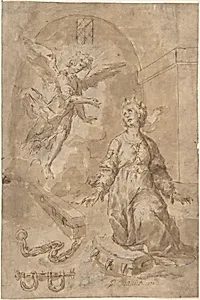
An Angel Appearing to Saint Catherine of Alexandria in Prison (recto); Volute (verso)
Medium
Pen and brown ink with brush and brown wash, highlighted with white gouache (now mostly oxidized) over traces of black chalk (recto). Composition outlined with graphite. On light beige paper. Red chalk (verso)
Dimensions
11-9/16 x 7-11/16 in. (29.4 x 19.5 cm)
Classification
Drawings
Department
Drawings and Prints
Museum
Metropolitan Museum of Art, New York, NY
Credit
Gift of Mr. and Mrs. William B. Jaffe, 1956
Accession Number
56.235.76
Rights
Public Domain
Tags
Art Historical Context
In the recto of this evocative 17th-century drawing the Spanish School of Seville, an angel appears to Saint Catherine of in her prison cell, a poignant moment from the saint's hagiography. Catherine, a revered Christian martyr known for her intellect and defiance against Roman persecution, endured imprisonment before her execution. This anonymous work captures the divine intervention with tender drama, highlighting the Baroque era's emphasis on spiritual ecstasy and human suffering—hallmarks of Seville's vibrant art scene, influenced by masters like Zurbarán and Murillo. Executed in pen and brown ink with brush and brown wash, the sheet employs subtle white gouache highlights (now oxidized) over black chalk traces for luminous effects, evoking the angel's ethereal glow amid the prison's shadows. The light beige paper and graphite outlines add precision, while the verso features a red chalk volute, a classical scroll motif suggesting the artist's multifaceted practice in architectural or decorative studies. Such preparatory drawings were vital in Seville's workshops, bridging sketch to altarpiece. Housed in the Metropolitan Museum of Art as a 1956 gift from Mr. and Mrs. William B. Jaffe, this double-sided gem offers a window into 17th-century Spanish devotion, where art served faith amid Counter-Reformation fervor, blending realism with mysticism for profound emotional impact.