
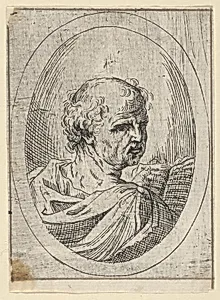
An apostle seen from behind and turning to the right, holding an open book, in an oval frame, from Christ, the Virgin, and Thirteen Apostles
1600–1640
Medium
Etching
Dimensions
Sheet: 4 1/16 × 2 15/16 in. (10.3 × 7.5 cm)
Classification
Prints
Department
Drawings and Prints
Museum
Metropolitan Museum of Art, New York, NY
Credit
Harris Brisbane Dick Fund, 1926
Accession Number
26.70.4(114)
Rights
Public Domain
Tags
Art Historical Context
This delicate etching by Guido Reni, created between 1600 and 1640, captures an apostle viewed from behind as he turns gracefully to the right, cradling an open book. Part of a larger series depicting Christ, the Virgin Mary, and the thirteen apostles, the small print—measuring just over four by three inches—uses an oval frame to focus attention on the figure’s expressive pose and flowing drapery. Reni, a master of the Bolognese Baroque, infused even modest works like this with a sense of dignified movement and classical harmony. Etching allowed Reni’s designs to reach a wide audience through affordable prints, spreading his elegant style across Europe. The apostle’s turned stance and the open book suggest quiet revelation, inviting viewers to imagine the sacred text he holds. Though the artist’s name appears alongside an anonymous 17th-century attribution, the refined linework and balanced composition reflect Reni’s characteristic pursuit of ideal beauty in religious subjects. Housed in the Metropolitan Museum of Art’s collection of prints and drawings, this intimate work offers a window into Baroque devotional imagery. Its modest scale encourages close looking, rewarding visitors with subtle details of gesture and form that speak to the era’s deep engagement with faith and artistic grace.
About the Artist
Guido Reni|Anonymous, 17th century · 1575–1642
Guido Reni (1575–1642) was one of the most celebrated Italian painters of the Baroque era and the dominant figure of the Bolognese School. Born into a family of musicians in Bologna, he trained first with Denys Calvaert before joining the influential Accademia degli Incamminati led by Ludovico Carracci. Reni achieved international fame through his idealizing style that combined Baroque dynamism wi...