
An April Shower: A View from Binsey Ferry Near Oxford, Looking Towards Port Meadow and Godstow
1842
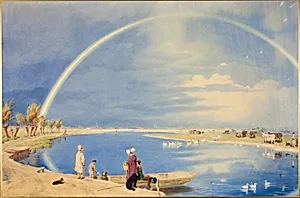
Medium
Watercolor over graphite, with scraping, on cream wove paper
Dimensions
45.5 × 68.5 cm (17 15/16 × 27 in.)
Classification
paper
Department
Prints and Drawings
Museum
Art Institute of Chicago
Accession Number
183043
Rights
Public Domain
About this artwork
William Turner of Oxford belongs to the second generation of great English watercolorists, known for their Romantic obsession with nature as a source of values and for their belief in the cult of the picturesque. He tried to maintain the topographic specificity seen in works of earlier eras while elevating watercolor landscapes to the level of moral enhancement. This idea is illustrated here by the harmony of humans and animals; the importance of family is underscored by an arcing rainbow.
Art Historical Context
Step into the misty charm of an English spring with *An April Shower: A View Binsey Ferry Near Oxford Looking Towards Port Meadow andstow* (1842), a luminous watercolor by the legendary British artist J.M.W. Turner. Capturing a panoramic vista from the banks of the Thames near Oxford, the scene unfolds across lush meadows and historic landmarks like the ruins of Godstow Abbey bathed in the fleeting drama of a passing rain shower. Turner, a Romantic master of light and atmosphere, sketched this during his later travels through Britain, evoking the sublime beauty of everyday landscapes transformed by nature's whims. Rendered in watercolor over graphite on cream wove paper (45.5 × 68.5 cm), Turner's innovative technique shines here: delicate pencil underdrawings guide vibrant washes of color, while scraping reveals glowing highlights to mimic rain-slicked grass and shimmering water. This method, honed over decades, allowed him to convey ephemerality—clouds parting to reveal sunlight—in a single sheet, pushing watercolor from mere illustration to high art. Housed in the Art Institute of Chicago's Prints and Drawings collection, it exemplifies Turner's influence on Impressionism and modern landscape painting. Imagine visitors in 1840s England marveling at such vivid weather effects; today, it invites us to pause and appreciate the poetry in a simple April shower.