
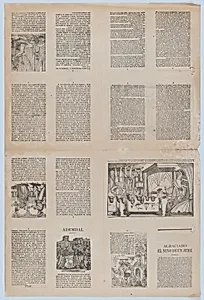
An uncut sheet printed on both sides with pages from 'Ademdai' and 'Agraciado: El niño de un jeme'
ca. 1900–1910
Medium
Ethching on zinc and lettepress (relief printing)
Dimensions
Sheet: 23 5/8 × 15 3/4 in. (60 × 40 cm)
Classification
Prints
Department
Drawings and Prints
Museum
Metropolitan Museum of Art, New York, NY
Credit
The Elisha Whittelsey Collection, The Elisha Whittelsey Fund, 1946
Accession Number
46.46.70
Rights
Public Domain
Art Historical Context
This uncut sheet, printed on both sides with pages from *Ademdai* and *Agraciado: El de un jeme*, the collaborative genius of Mexican printmaker José Guadalupe Posada publisher Antonio Vanegas Arroyo 1900–1910. Posada, renowned for his broadsheets and iconic calaveras (skeleton figures), created vivid zinc etchings—durable metal relief plates that allowed for sharp, reproducible illustrations—paired with letterpress text for affordable chapbooks and corridos (illustrated ballads). Measuring 23⅝ × 15¾ inches, this double-sided sheet reveals the pre-trimming production process, offering a rare glimpse into early 20th-century Mexican printing workshops. These publications likely featured popular tales or moral stories, blending Posada's dynamic, folk-inspired imagery with Arroyo's mass-market distribution. During Mexico's Porfiriato era, such prints democratized art, reaching everyday readers with commentary on society, death, and folklore. The zinc etching technique, a Posada hallmark, produced bold lines and textures suited to his caricatured style, influencing later Mexican graphic arts and even Diego Rivera's work. Housed in the Metropolitan Museum of Art's Drawings and Prints department, this artifact highlights the cultural vibrancy of Mexico's print revolution, where art met literature to entertain and provoke the masses. A testament to ingenuity on a shoestring budget!
About the Artist
José Guadalupe Posada|Antonio Vanegas Arroyo · 1852–1913
José Guadalupe Posada (1852-1913) was a Mexican printmaker and engraver who revolutionized popular art and created some of the most iconic images in Mexican culture. Working primarily with publisher Antonio Vanegas Arroyo, he produced over 20,000 images during his career—inexpensive broadsheets sold for a penny on colored paper that made his art accessible to even the poorest workers. He transform...