
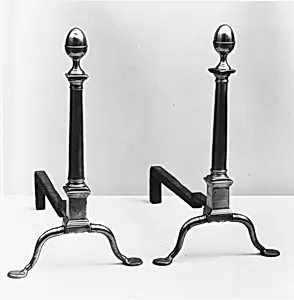
Andiron
Unknown Artist
1770–1800
Medium
Brass
Dimensions
20 3/4 x 19 1/2 x 11 3/4 in. (52.7 x 49.5 x 29.8 cm)
Classification
Andiron
Department
The American Wing
Museum
Metropolitan Museum of Art, New York, NY
Credit
Bequest of W. Gedney Beatty, 1941
Accession Number
41.160.346
Rights
Public Domain
Art Historical Context
### Andiron, 1770–1800 This elegant brass andiron, crafted between 1770 and 1800 by an unknown artisan, stands as a testament to early American metalworking prowess. Measuring 20 3/4 x 19 1/2 x 11 3/4 inches, it was designed as one of a pair to support burning logs in a fireplace, them for better airflow and heat distribution. Brass, prized for its durability, golden sheen, and resistance to corrosion, was a favored material in colonial households, often polished to a brilliant luster that reflected the fire's glow. Housed in The Metropolitan Museum of Art's American Wing and bequeathed by W. Gedney Beatty in 1941, this piece evokes the hearths of late 18th-century America—spanning the Revolutionary era through the early Federal period. Fireplaces were the heart of domestic life, providing warmth, light, and a gathering spot. Ornate andirons like this one adorned affluent homes, blending utility with subtle decoration to signify taste and status amid a young nation's growing refinement. Though the artist remains anonymous, the andiron's robust form and smooth casting highlight skilled foundry techniques, possibly influenced by British imports or local workshops. It offers visitors a tangible glimpse into everyday colonial luxury, reminding us how even functional objects carried artistic flair.