
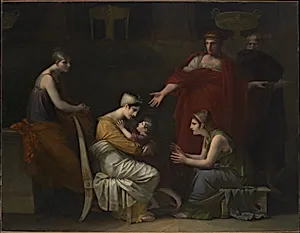
Andromache and Astyanax
?1813–17; 1823–24?
Medium
Oil on canvas
Dimensions
52 x 67 1/8 in. (132.1 x 170.5 cm)
Classification
Paintings
Department
European Paintings
Museum
Metropolitan Museum of Art, New York, NY
Credit
Bequest of Collis P. Huntington, 1900
Accession Number
25.110.14
Rights
Public Domain
Tags
Art Historical Context
This evocative painting depicts Andromache, the widow of the Trojan hero Hector, alongside her young son Astyanax in the aftermath of the Trojan War. The scene draws from classical mythology, capturing themes of maternal love, loss, and vulnerability as the family faces an uncertain fate following Troy’s fall. The figures—rendered with emotional intensity—highlight the human cost of ancient conflict, with Andromache’s protective gesture toward the boy underscoring enduring bonds amid tragedy. Begun by Pierre-Paul Prud’hon around 1813–17 and completed by his collaborator Charles Pompée Le Boulanger de Boisfrémont between 1823 and 1824, the work reflects the neoclassical tradition with its refined composition and dramatic lighting. Prud’hon, known for his graceful figures and subtle emotional depth, often blended classical ideals with a softer, more romantic sensibility. Executed in oil on canvas, the medium allowed for rich tonal contrasts and delicate modeling of forms, enhancing the intimate scale of this 52-by-67-inch composition now in the Metropolitan Museum of Art’s European Paintings collection.
About the Artist
Pierre Paul Prud'hon|Charles Pompée Le Boulanger de Boisfrémont · 1758–1823
Pierre Paul Prud'hon (1758–1823) was a French painter and draughtsman whose dreamy, sensuous art occupied a singular position between the Neoclassicism and Romanticism that competed for dominance in French painting around 1800. Born in Cluny in Burgundy, he received his early artistic training at the Dijon Academy before winning the Prix de Rome of the Estates of Burgundy, which allowed him to spe...