
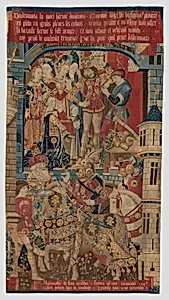
Andromache and Priam Urging Hector Not to Go to War (from Scenes from the Story of the Trojan War)
ca. 1470–90
Medium
Wool warp, wool wefts with a few silk wefts.
Dimensions
Overall: 190 x 104in. (482.6 x 264.2cm)
Classification
Textiles-Tapestries
Culture
South Netherlandish
Department
Medieval Art
Museum
Metropolitan Museum of Art, New York, NY
Credit
Fletcher Fund, 1939
Accession Number
39.74
Rights
Public Domain
Tags
Art Historical Context
This stunning South Netherlandish tapestry woven by Pasquier Grenier Tournai around 1470–90, a poignant moment from Homer's *Iliad*: Androm, Hector's devoted wife, and Priam, the aged king of Troy, desperately urging the hero not to venture into battle. Part of a larger series illustrating the Trojan War, it vividly brings to life the human drama amid epic conflict—families torn by fate, with horses, warriors, and emotional pleas rendered in intricate detail. At nearly 16 feet tall and 9 feet wide, its monumental scale would have dominated medieval halls, serving as both decoration and moral storytelling for nobility. Crafted on a wool warp with primarily wool wefts accented by silk for richer highlights, this high-quality weave exemplifies Tournai's mastery in tapestry production, a pinnacle of late medieval artistry. South Netherlandish workshops like Grenier's were renowned for their technical precision, using hundreds of thousands of knots to create lifelike figures and lush landscapes. These luxurious textiles, often commissioned for churches or palaces, blended classical mythology with Christian-era sensibilities, reminding viewers of valor, loss, and the futility of war. Housed in the Metropolitan Museum of Art's Medieval Art collection (Fletcher Fund, 1939), this piece offers a window into 15th-century fascination with antiquity, preserving the Trojan saga's timeless themes for modern eyes.