
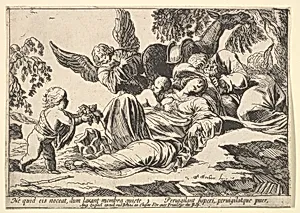
Angels Giving Fruit to the Sleeping Holy Family
1610–42
Medium
Etching
Dimensions
4 7/16 x 6 3/16 in. (11.3 x 15.7 cm)
Classification
Prints
Department
Drawings and Prints
Museum
Metropolitan Museum of Art, New York, NY
Credit
Gift of Harry G. Friedman, 1959
Accession Number
59.644.112(2)
Rights
Public Domain
Tags
Art Historical Context
In the delicate etching *Angels Giving Fruit to Sleeping Holy Family*, French artist Pierre Brebiette captures a tender biblical moment from around 1610–42. The intimate scene depicts ethereal angels gently offering fruit to the resting Virgin Mary, Joseph, and infant Jesus—likely evoking the Holy Family's sojourn during their flight to Egypt. Rendered on a small scale (4 7/16 x 6 3/16 in.), this print invites close contemplation, its fine lines conveying serenity, divine care, and familial warmth amid the tags of sleeping figures, men, women, and celestial beings. Brebiette, active in early 17th-century France, bridged Mannerism's elegant distortions with emerging Baroque naturalism, using etching—a revolutionary intaglio technique involving acid-bitten metal plates—to produce detailed, reproducible images. This medium democratized religious art, allowing wider devotion during the Counter-Reformation's emphasis on emotional piety. Today, this gift to the Metropolitan Museum of Art's Drawings and Prints department exemplifies Brebiette's mastery of light, texture, and narrative grace, offering visitors a window into 17th-century spiritual life through a remarkably preserved, pocket-sized masterpiece.
About the Artist
Pierre Brebiette · 1598–1642
Pierre Brébiette (c. 1598–c. 1642) was a French painter and etcher whose elegant, sensuous treatment of classical mythology and allegory earned him a significant reputation in early seventeenth-century Paris. Born in Mantes-sur-Seine, Brébiette traveled to Italy as a young man and lived and worked in Rome from around 1617 to approximately 1625, absorbing the influences of ancient sculpture, Renais...