
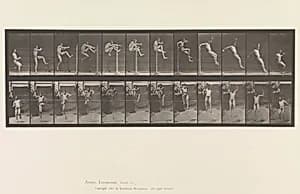
Animal Locomotion. An Electro-Photographic Investigation of Consecutive Phases of Animal Movements. Commenced 1872 - Completed 1885. Volume V, Man (Pelvis Cloth)
1880s
Medium
Photogravures
Classification
Books
Department
Photographs
Museum
Metropolitan Museum of Art, New York, NY
Credit
Rogers Fund, transferred from the Library
Accession Number
1991.1135.5
Rights
Public Domain
Tags
Art Historical Context
Eadweard Muybridge’s monumental project *Animal Locomotion* represents one of the most ambitious photographic studies of movement ever undertaken. Begun in 1872 and completed in 1885, this encyclopedic work comprises thousands of sequential images that broke down the of humans and animals into individual phases. Volume V, to male figures, captures men in everyday and athletic motions while wearing only a minimal pelvis cloth, allowing clear observation of the body’s mechanics. The plates were produced as photogravures, an intaglio printing process prized in the nineteenth century for its rich tonal range and ability to reproduce photographic detail at scale. By arranging multiple exposures in grid-like sequences, Muybridge transformed a single action into a visual narrative, revealing subtleties of posture and muscle coordination invisible to the naked eye. Housed today in the Metropolitan Museum of Art’s collection as a bound volume of photographs, the work bridges scientific inquiry and artistic exploration. Its systematic approach laid essential groundwork for later developments in cinema and modern art’s fascination with time and motion.
About the Artist
Eadweard Muybridge · 1830–1904
Eadweard Muybridge (1830-1904) was an English-American photographer who revolutionized the understanding of motion through his pioneering chronophotographic studies. Born Edward James Muggeridge in Kingston upon Thames, England, he emigrated to America and became famous first for his dramatic landscape photographs of Yosemite Valley, then for his groundbreaking motion studies that proved horses li...