
Ankunfft Und herkommen der weitberümbten herrlichen Statt Venedig Sambt derselben gewaltigen Herrschafft
1679
Medium
paper
Dimensions
380; 433; 272; 343
Rights
Public Domain
About this artwork
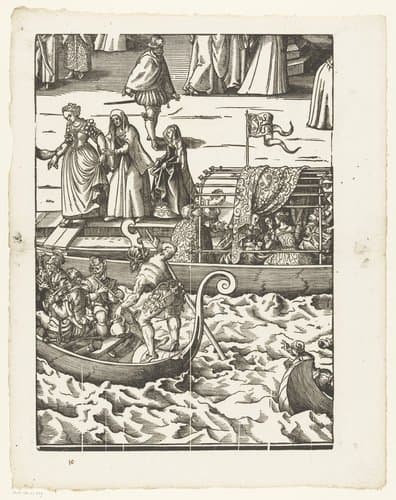
Processie van de doge op Hemelvaartsdag over het San Marcoplein te Venetië. De processie leidt naar de Bucintoro, de galei van de doge. Eens per jaar 'huwde' de doge tijdens het Festa della Sensa op ceremoniële wijze met de Adriatische Zee door vanaf deze galei een ring in het water te werpen.
Art Historical Context
Behold *Ankunfft Und herkommen weitberümbtenlichen Statt Vened Sambt derselben gewigen Herrschafft*Arrival and Origin of the Renowned Magnificent City of and Its Powerful Dominion), a captivating 1679 engraving on paper by Jost Am (1539–1591), measuring 433 × 343 mm. This detailed work vividly captures the grand procession of Venice's doge on Ascension Day across the iconic Piazza San Marco, winding toward the ornate Bucintoro—the doge's ceremonial galley. The scene commemorates the *Festa della Sensa* (Feast of the Ascension), a cherished annual ritual where the doge symbolically "married" the Adriatic Sea. From the Bucintoro, he would cast a ring into the waters, affirming Venice's maritime supremacy and prosperity as a seafaring republic. This tradition, rooted in medieval lore and renewed in the 10th century, underscored the city's identity as "Bride of the Sea," blending piety, pageantry, and political power during Venice's Golden Age. Amman's masterful engraving technique, renowned for its intricate line work and bustling crowd scenes, brings the opulent spectacle to life—nobles in lavish robes, musicians, and flag-bearers converging on the lagoon. As a window into 16th-17th century Venetian splendor, it highlights the era's cultural pomp and Amman's skill in documenting historical events for a fascinated European audience.
About the Artist
Jost Amman · 1539–1591
Jost Amman (1539–1591) was a Swiss-born woodcut designer, engraver, and illustrator who became one of the most prolific and influential graphic artists of sixteenth-century Germany, producing an output of extraordinary range and technical virtuosity that shaped the visual culture of the later Reformation era. Born in Zurich, Amman moved to Nuremberg around 1560, the city that had been the center o...