
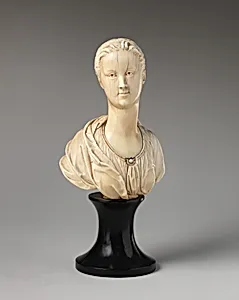
Anne Spencer, Countess of Sunderland (1683–1716)
ca. 1710, with later socle
Medium
Ivory; socle: ebony (non-original)
Dimensions
Height: 5 1/2 in. (14 cm)
Classification
Sculpture-Miniature
Culture
British
Department
European Sculpture and Decorative Arts
Museum
Metropolitan Museum of Art, New York, NY
Credit
Bequest of Irwin Untermyer, 1973
Accession Number
1974.28.148
Rights
Public Domain
Tags
Art Historical Context
This exquisite ivory miniature portrait bust by David Le Marchand captures Anne Spencer, Countess of (1683–1716), a notable British poet and aristocrat, around 1710. Standing just 5½ inches tall, the sculpture exemplifies the intimate scale of 18th-century portrait mini, which were prized for their portability and personal appeal among the elite. Le Marchand, a skilled Huguenot carver working in England, rendered the Countess with remarkable detail—her lace collar, pearl earrings, and poised expression evoking the elegance of the Augustan age. Carved from ivory, a luxurious medium that allowed for translucent depth and lifelike texture, the bust highlights Le Marchand's mastery of relief and subtle modeling. It later acquired a non-original ebony socle, enhancing its display as a tabletop gem. As a portrait of a woman known for her literary circle, including ties to early Enlightenment figures, the piece bridges portraiture and cultural patronage, reflecting how nobility commissioned such works to commemorate intellect alongside status. Today, housed in the Metropolitan Museum of Art's European Sculpture and Decorative Arts collection (Bequest of Irwin Untermyer, 1973), this rarity invites visitors to ponder the refined artistry of Georgian Britain and the enduring legacy of female poets like Anne Spencer.