
Another Impossible Task
Medium
Salted paper print from glass negative
Dimensions
Image: 16.3 x 21.2 cm (6 7/16 x 8 3/8 in.) Sheet: 13 3/8 × 18 1/8 in. (34 × 46 cm)
Classification
Photographs
Department
Photographs
Museum
Metropolitan Museum of Art, New York, NY
Credit
Gilman Collection, Gift of The Howard Gilman Foundation, 2005
Accession Number
2005.100.372.32
Rights
Public Domain
Tags
Art Historical Context
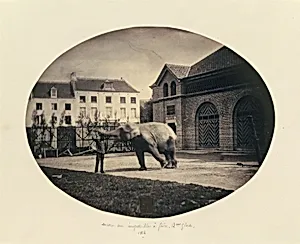
"Another Impossible Task" (1854) is a captivating salted paper print from a glass negative by French photographer Louis-Pierre-Théophile de Nehaut. 16.3 x 21.2 cm, this early photograph captures a scene blending human ambition with the wild unpredictability of nature, featuring men, elephants, and sturdy buildings. The evocative title hints at the Herculean challenge depicted—likely men grappling with the immense power of elephants in an urban or architectural setting, a nod to colonial-era encounters in regions where such beasts roamed. Created during photography's formative years, the work exemplifies the salted paper process, where a paper sensitized with salt and silver nitrate receives a detailed image from a glass negative. This technique, bridging William Henry Fox Talbot's calotype innovations with emerging glass-plate precision, allowed for sharper details and multiple prints—revolutionary for 1854. Housed in the Metropolitan Museum of Art's Gilman Collection, it highlights the medium's role in documenting exotic adventures and everyday impossibilities. Dubois de Nehaut's image invites viewers to ponder humanity's limits against nature's might, blending documentary realism with subtle narrative drama. A gem of 19th-century photography, it reminds us how early lenses froze fleeting "impossible" moments for eternity.
About the Artist
Louis-Pierre-Théophile Dubois de Nehaut · 1799–1872
Louis-Pierre-Théophile Dubois de Nehaut (1799–1872) was a French artist and early enthusiast of photography whose career bridged the worlds of traditional draughtsmanship and the new mechanical image-making technologies that transformed visual culture in the nineteenth century. Trained in the conventions of French academic art, he possessed the skills of a practiced draughtsman before turning his ...