
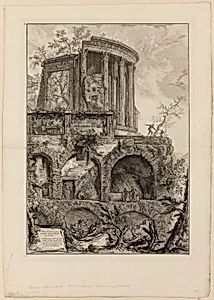
Another view of the Temple of the Sibyl in Tivoli, from Views of Rome
1761, published 1800–07
Medium
Etching on heavy laid paper
Dimensions
Image: 62.1 × 43.8 cm (24 1/2 × 17 1/4 in.); Plate: 62.6 × 44.3 cm (24 11/16 × 17 1/2 in.); Sheet: 79.2 × 56.4 cm (31 3/16 × 22 1/4 in.)
Classification
etching
Department
Prints and Drawings
Museum
Art Institute of Chicago
Accession Number
64618
Rights
Public Domain
Art Historical Context
Step into the sun-drenched ruins of ancient Rome with Giovanni Battista Piranesi's * view of the Temple of the Sibyl in Tivoli from Views of Rome*1761, published 1800–). This magnificent etching captures the iconic round Temple of Vesta—often called the Temple of the Sibyl—in Tivoli, just outside Rome. Piranesi, a visionary 18th-century Italian and architect, immortalized the Eternal City's ancient wonders in his seminal *Vedute di Roma* series, blending meticulous documentation with dramatic flair to evoke the sublime power of antiquity. Printed on heavy laid paper, the etching measures an impressive 62.1 × 43.8 cm, allowing Piranesi's virtuoso technique to shine. His intricate line work creates depth, shadow, and texture, transforming flat paper into a theatrical vista of crumbling columns and lush foliage. As a master of etching, Piranesi scratched directly into copper plates, layering fine details to convey scale and atmosphere—techniques that made his prints collector's treasures across Europe. Housed in the Art Institute of Chicago's Prints and Drawings Department, this work highlights the 18th-century fascination with classical ruins, fueling the Grand Tour and Neoclassical revival. It invites us to ponder Rome's enduring legacy, where every shadow whispers of gods and emperors long past.
About the Artist
Giovanni Battista Piranesi · 1720–1778
Giovanni Battista Piranesi (1720–1778) was an Italian printmaker, architect, and antiquarian whose visionary etchings of Rome and imaginary prisons revolutionized architectural representation and profoundly influenced both Neoclassicism and Romanticism. Piranesi stands as one of the most important printmakers of the eighteenth century, fundamentally shaping European perceptions of ancient Rome an...