
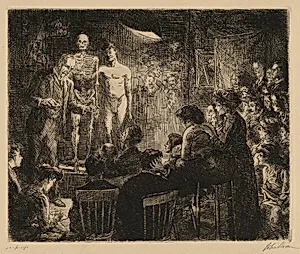
Anshutz on Anatomy
1912
Medium
etching in black on wove paper
Dimensions
plate: 18.7 x 22.8 cm (7 3/8 x 9 in.) sheet: 29.8 × 39.4 cm (11 3/4 × 15 1/2 in.)
Classification
Department
CG-W
Museum
National Gallery of Art, Washington, D.C.
Credit
Rosenwald Collection
Accession Number
1964.8.1874
Rights
Public Domain
Art Historical Context
John Sloan’s 1912 etching *Anshutz on Anatomy* captures a moment of artistic instruction with quiet intimacy. Created in black ink on wove paper, the print shows Thomas Anshutz—Sloan’s former teacher at the Pennsylvania Academy of the Fine Arts—lecturing on human anatomy. The medium of etching, with its fine, precise lines, was ideally suited to Sloan’s interest in everyday scenes and allowed him to record the classroom setting in rich detail while keeping the focus on the exchange between teacher and students. As a leading figure of the Ashcan School, Sloan often turned his attention to the realities of modern American life. Here he honors the foundational training that shaped his generation of artists, highlighting the rigorous study of the human form that underpinned the lively urban paintings for which he became known. The work’s modest scale and print format made it accessible to a broad audience, reflecting the democratic spirit of early twentieth-century American realism. Today in the National Gallery of Art’s Rosenwald Collection, the etching offers visitors a glimpse into the shared studio culture that nurtured some of the most influential American artists of the era.
About the Artist
John Sloan · 1871–1951
John French Sloan was born on August 2, 1871, in Lock Haven, Pennsylvania, and grew up in Philadelphia, where he taught himself to draw largely through self-study and reproductions before taking evening classes at the Pennsylvania Academy of the Fine Arts under Thomas Anshutz around 1892. That same year he met the painter Robert Henri, who became his closest friend and most influential mentor, enc...