
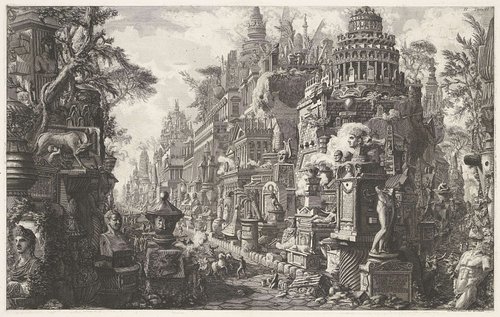
Antiquus bivii viarum appiae et ardeatinae prospectus ad II lapidam extra portam capenam
ca. 1756 - ca. 1757
Medium
etching
Dimensions
398; 637
Rights
Public Domain
About this artwork
collector's mark: Lugt 2228
Art Historical Context
**Antiquus Bivii Viarum Appiae et Aratinae Prospectus ad II Lapidem Extra Portam Capen** *Giovanni Battista Piranesi,. 1756–1757, etching, 398 × 637 mm* Giovanni Battista Piranesi, the visionary 18th-century Italian and architect, masterfully captures the timeless allure of ancient Rome in this expansive etching. Depicting the ancient junction—or *bivium*—of the Via Appia (Appian Way) and Via Ardeatina at the second milestone just beyond the Porta Capena, the print transports viewers to the outskirts of the Eternal City. Created during Piranesi's prolific period in Rome, it belongs to his celebrated *Vedute di Roma* series, which romanticized classical ruins for Grand Tour travelers and scholars across Europe. Piranesi's etching technique shines here, with intricate, densely hatched lines evoking the weathered textures of stone milestones, overgrown pathways, and monumental arches. The large format allows for dramatic perspective, drawing the eye into vast, atmospheric depths that blend meticulous archaeological accuracy with imaginative grandeur. This work underscores the cultural revival of antiquity during the Enlightenment, highlighting Rome's engineering marvels like the Appian Way—the oldest and most famous Roman road, built in 312 BCE. Adorned with a collector's mark (Lugt 2228), this piece exemplifies Piranesi's enduring influence on neoclassicism and printmaking, inviting us to ponder the whispers of history amid ruins. (198 words)
About the Artist
Giovanni Battista Piranesi · 1720–1778
Giovanni Battista Piranesi (1720–1778) was an Italian printmaker, architect, and antiquarian whose visionary etchings of Rome and imaginary prisons revolutionized architectural representation and profoundly influenced both Neoclassicism and Romanticism. Piranesi stands as one of the most important printmakers of the eighteenth century, fundamentally shaping European perceptions of ancient Rome an...