
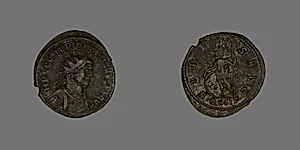
Antoninianus (Coin) Portraying Emperor Diocletian
about 285
Medium
Billon
Dimensions
Diam.: 2.4 cm (1 in.)
Classification
coin
Department
Arts of Greece, Rome, and Byzantium
Museum
Art Institute of Chicago
Accession Number
141670
Rights
Public Domain
About this artwork
The front (obverse) of this coin portrays the head of Emperor Diocletian, facing to the right. On the back (reverse), a soldier stands facing to the left, holding a spear in his left hand and resting his right arm on a shield.
Art Historical Context
This small yet mighty Antoninianus coin, struck around 285 CE during the early reign of Emperor Diocian, captures the essence of late Roman imperial power. Made of billon—a debased alloy of bronze with traces of silver—the 2.4 cm diameter features Diocletian on the obverse, likely adorned with a radiate crown, a hallmark of the Antoninianus denomination introduced earlier in the third century. Reveres typically depicted deities like Jupiter or Victory, symbolizing divine favor and military triumph. Diocletian (r. 284–305 CE) ascended amid the Crisis of the Third Century, a chaotic era of invasions, civil wars, and economic collapse. This coin reflects his initial efforts to stabilize the empire through monetary reforms, though billon's low silver content highlights ongoing inflation woes he later addressed with his famous Edict on Maximum Prices in 301 CE. As propaganda tools, Roman coins like this circulated empire-wide, reinforcing the emperor's image from Britain to Egypt. In the Art Institute of Chicago's Arts of Greece, Rome, and Byzantium collection, this piece exemplifies the artistry of Roman die-struck coinage—precise engraving on metal dies created finely detailed portraits amid economic strain. It invites us to ponder how even pocket change shaped history, blending craftsmanship, politics, and daily life in antiquity.
About the Artist
Ancient Roman
The artists attributed to "Ancient Roman" in museum collections represent the anonymous craftsmen who produced the vast output of sculpture, frescoes, mosaics, and reliefs defining Roman visual culture from the Republic (c. 509–27 BCE) to the late Empire (c. 395 CE). Individual identities remain elusive, as Roman makers were typically viewed as skilled tradesmen—often enslaved Greeks or provincial...