
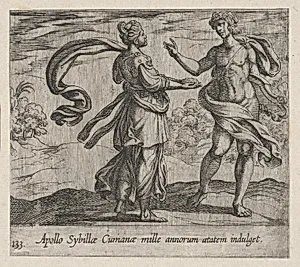
Apollo Granting the Cumaean Sybil's Wish (Apollo Sybillae Cumanae mille annorum atatem indulget), from Ovid's The Metamorphoses, plate 133
1606
Medium
Etching
Dimensions
Sheet: 4 in. × 4 9/16 in. (10.2 × 11.6 cm)
Classification
Prints
Department
Drawings and Prints
Museum
Metropolitan Museum of Art, New York, NY
Credit
The Elisha Whittelsey Collection, The Elisha Whittelsey Fund, 1951
Accession Number
51.501.3984
Rights
Public Domain
Tags
Art Historical Context
In Antonio Tempesta's etching *Apollo Granting the Cuman Sibyl's Wish* (1606), we witness a pivotal moment from Ovid's *Metamorphoses*. The Cumaean Sibyl, a prophetess, beseeches Apollo for a lifespan as long as the grains of sand she holds—typically interpreted as a thousand years. The god, struck by her ambition yet forgetting to grant eternal youth, fulfills her wish, setting the stage for her tragic withering into old age. Tempesta, a prolific Italian Mannerist artist active in Rome and Florence, captures this mythological drama with dynamic figures and expressive gestures, part of his renowned 1606 series of 138 plates illustrating Ovid's epic tales of transformation. Etching, Tempesta's chosen medium, allowed for intricate line work etched into a copper plate with acid, enabling the production of detailed, affordable prints that popularized classical stories across Europe during the early Baroque era. At just 4 by 4 9/16 inches, this intimate sheet exemplifies the technical precision of printmaking, blending Tempesta's elegant, elongated forms—hallmarks of Mannerism—with vivid narrative energy. Housed in the Metropolitan Museum of Art's Elisha Whittelsey Collection, this print highlights the Renaissance revival of antiquity, bridging ancient myth with 17th-century artistry. Visitors are drawn to its timeless theme of unintended consequences, reminding us how desires can reshape destinies.
About the Artist
Antonio Tempesta · 1555–1630
Antonio Tempesta (1555–1630), known as 'Il Tempestino,' was a Florentine painter and printmaker whose extraordinary output of approximately 1,700 etchings made him one of the most influential printmakers of the early Baroque period. Born in Florence and trained under Santi di Tito and the Flemish master Joannes Stradanus, he enrolled in the Accademia del Disegno in 1576 before relocating to Rome i...