
Apostel Jacobus de Oude
c. 1500 - c. 1600
Medium
jet (coal)
Dimensions
7.3
Rights
Public Domain
About this artwork
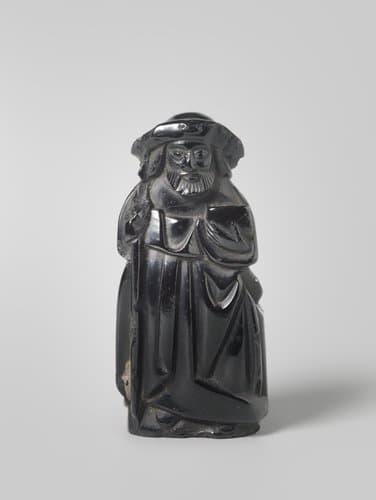
De heilige staat frontaal, heeft in de rechterhand een staf en in de linker een boek. Hij draagt een wijde mantel en een grote hoed, die aan de voorkant is voorzien van een schelp.
Art Historical Context
This small yet striking sculpture, titled *Apostel Jacobus Oude* (Apostle James Greater), depicts the revered saint standing frontally in a poised, devotional pose. Crafted anonymously around 1500–1600, it measures just 7.3 cm in height, making it a perfect pocket-sized devotional object. James holds a staff in his right hand—symbolizing his pilgrim journeys—and a book in his, evoking his apostolic teachings. He is clad in a flowing mantle and a wide-brimmed hat adorned with aop shell at the front, the iconic emblem of the Camino de Santiago pilgrimage. Carved from jet, a dense black lignite prized for its smooth polish and luster, the piece showcases the intricate carving techniques of the late medieval to early Renaissance period. Jet, often sourced from European deposits, was a favored medium for affordable religious artifacts, lending a gem-like quality to humble piety items. Its dark sheen enhances the solemnity, inviting tactile contemplation. Historically, this artwork reflects the era's fervent Catholic devotion amid the Renaissance, when pilgrimage to James's shrine in Santiago de Compostela peaked. Such sculptures served pilgrims as talismans, blending personal faith with cultural tradition and underscoring the saint's enduring role as protector of travelers. A gem of anonymous artistry, it whispers stories of faith across centuries.
About the Artist
anonymous
In the vast tapestry of art history, "Anonymous" stands not as a singular individual but as a collective designation for countless unidentified creators whose works have endured across millennia. These artists, spanning prehistoric cave painters to medieval illuminators and folk craftsmen, produced the foundational layers of human visual culture. Prior to the Renaissance, when individual fame emer...