
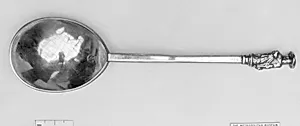
Apostle spoon
Unknown Artist
1639–40
Medium
Silver gilt
Dimensions
Length: 7 1/4 in. (18.4 cm)
Classification
Metalwork-Silver
Culture
British, London
Department
European Sculpture and Decorative Arts
Museum
Metropolitan Museum of Art, New York, NY
Credit
Rogers Fund, 1913
Accession Number
13.41.38
Rights
Public Domain
Tags
Art Historical Context
Step back to 17th-century London with this exquisite *Apostle spoon*, around 1639–40 by an unknown silversmith. Measuring 7¼ inches (18.4 cm) in length, this delicate piece of silver gilt—silver coated with a thin layer of gold for a luxurious sheen—was hallmarks-stamped in the British capital, a hub of fine metalwork during the reign of Charles I. Housed in the Metropolitan Museum of Art's European Sculpture Decorative Arts department (quired via the Rogers Fund in 191), it exemplifies the artistry of the Metalwork-Silver classification. Apostle spoons like this one were prized possessions, often part of sets depicting the Twelve Apostles (or thirteen including Christ), given as christening gifts or heirlooms symbolizing faith and prosperity. The finial, likely portraying one of the Apostles, showcases meticulous chasing and engraving techniques, blending religious devotion with everyday utility. In an era of religious turmoil, such objects bridged the sacred and secular, reflecting England's rich tradition of silversmithing. This survivor of Tudor-Stuart opulence invites us to ponder the hands that held it—perhaps at royal banquets or family rituals—offering a tangible link to Britain's cultural heritage.