
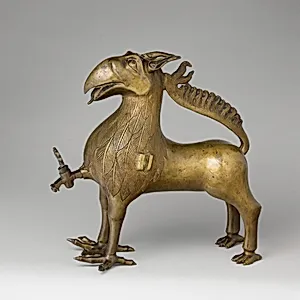
Aquamanile in the Form of a Griffin
Unknown Artist
ca. 1425–50
Medium
Bronze; Ternary copper alloy with a very high content of zinc (approx. 74% copper, approx. 22% zinc, approx. 2% lead) with natural patina, hollow cast.
Dimensions
H. 31.9 cm, w. 12 cm (chest without wings), l. 32.3 cm (including spout), wt. 3588 g and 488 g (wings).
Classification
Metalwork-Bronze
Culture
German, Nuremberg
Department
Robert Lehman Collection
Museum
Metropolitan Museum of Art, New York, NY
Credit
Robert Lehman Collection, 1975
Accession Number
1975.1.1413
Tags
Art Historical Context
Step into the world of late medieval metalwork with this striking *Aquamanile in the Form of a Griffin*, around 1425–50 in Nuremberg,—a hub of Renaissance-era craftsmanship. Aquamaniles like this were practical yet ornate ewers used for pouring water during handwashing rituals in churches, noble homes, or at banquets. Shaped as a fierce griffin, a mythical beast with the body of a lion and and wings of an eagle, embodies power and vigilance, guarding sacred spaces in both art and lore. Masterfully hollow-cast from a ternary copper alloy (about 74% copper, 22% zinc, and 2% lead), this bronze v...