
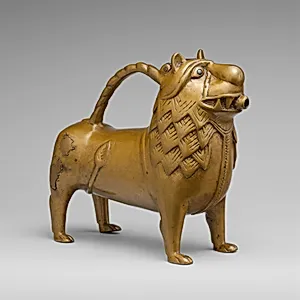
Aquamanile in the Form of a Lion
Unknown Artist
12th century
Medium
Copper alloy, glass inlays
Dimensions
Overall: 7 11/16 x 8 5/8 x 3 7/16 in. (19.5 x 21.9 x 8.7 cm) Thickness PD: 9/100-1/10 in. (0.22-0.25 cm) Weight PD: 72.9oz. (2067g)
Classification
Metalwork-Copper alloy
Culture
North German
Department
Medieval Art
Museum
Metropolitan Museum of Art, New York, NY
Credit
Gift of Irwin Untermyer, 1964
Accession Number
64.101.1491
Rights
Public Domain
Tags
Art Historical Context
Step into the world of medieval ingenuity with this striking *Aquamanile in the Form of a Lion a 12th-century German masterpiece from the Metropolitan Museum of Art's Medieval Art collection. Crafted from copper alloy—a durable metal prized for its workability and corrosion resistance—this vessel served as a ewer for pouring water during handwashing rituals. Common in ecclesiastical and noble settings, aquamaniles like this one elevated everyday hygiene into an artistic statement, often zoomorphic to evoke power and grace. The lion form, a tag-highlighted motif, symbolizes strength and nobility in medieval iconography, its fierce yet elegant posture capturing the era's blend of functionality and symbolism. Glass inlays likely accentuated the eyes, adding a sparkling, lifelike gleam that would have mesmerized users. Measuring just 7 11/16 x 8 5/8 x 3 7/16 inches and weighing nearly 5 pounds, its thin walls (0.22-0.25 cm) showcase expert lost-wax casting techniques, allowing intricate detailing while ensuring portability. Gifted by Irwin Untermyer in 1964, this anonymous artisan's work exemplifies North German metalwork's technical prowess and cultural vitality, bridging utility and artistry in the High Middle Ages.