
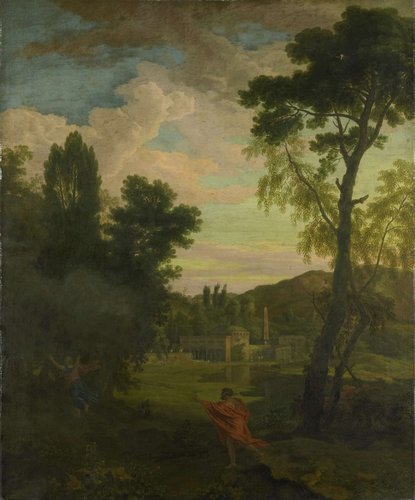
Arcadian Landscape with Jupiter and Io
1680 - 1726
Medium
oil on canvas
Dimensions
5.8; 4.2; 131.7; 160
Rights
Public Domain
About this artwork
buitenmaat: diepte 5,8 cm (drager incl. SK-L-4995)
Art Historical Context
Johannes Glauber's "Arcadian Landscape with Jupiter and Io" invites viewers into a serene, imagined world drawn from classical mythology. Created in oil on canvas between 1680 and 1726, the large-scale work (160 cm high) depicts the Roman god Jupiter in pursuit of the nymph Io amid an idealized pastoral setting. This subject, rooted in ancient tales of transformation and divine love, reflects the enduring fascination with Greco-Roman stories during the late Dutch Golden Age. Glauber, active in this period, specialized in such luminous Italianate landscapes that blended natural beauty with narrative elements. The oil medium allowed him to achieve rich atmospheric effects, subtle light play across hills and foliage, and a sense of depth that draws the eye through the scene. Housed in the Rijksmuseum, the painting exemplifies how Dutch artists of the era adapted classical themes to appeal to an educated audience seeking both elegance and escapism. Measuring over a meter and a half in height, the canvas commands attention while preserving fine details of its mythological encounter. It offers a timeless glimpse into how 17th- and 18th-century European art merged storytelling with the celebration of nature's harmony.
About the Artist
Johannes Glauber · 1646–1726
**Johannes Glauber (1646–c. 1726)** was a Dutch Golden Age painter renowned for his Italianate landscapes and decorative wall paintings. Born in Utrecht, he pursued art against the wishes of his father, the prominent chemist Johann Rudolph Glauber. He became a pupil of Nicolaes Berchem and lived for a time with Gerrit van Uylenburgh in Amsterdam, where he produced copies of Italianate landscapes f...