
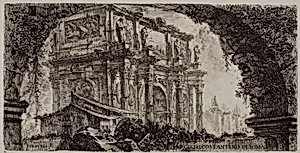
Arch of Constantine in Rome, plate 9 from Some Views of Triumphal Arches and other monuments
Medium
Etching on ivory laid paper
Dimensions
Plate: 13 × 26 cm (5 1/8 × 10 1/4 in.); Sheet: 34.3 × 46.4 cm (13 9/16 × 18 5/16 in.)
Classification
etching
Department
Prints and Drawings
Museum
Art Institute of Chicago
Accession Number
131469
Rights
Public Domain
Art Historical Context
Step into the grandeur of ancient Rome through Giovanni Battista Piranesi's masterful etching, *Arch of Constantine in Rome*, plate 9 from his 1748 series *Some Views of Triumphal Ar and other monuments*. This yet evocative print, measuring just 13 × 26 cm on its plate, captures the iconic triumphal erected in 315 AD celebrate Emperor Constantine's victory Maxentius at the Milvian Bridge—a pivotal moment that shaped early Christianity's rise in the empire. Piranesi a Venetian-born architect and engraver, immortalized Rome's ruins during the Enlightenment era, blending neoclassical precision with romantic drama to evoke the city's timeless majesty. Rendered in etching on ivory laid paper, Piranesi's technique shines through dense, swirling lines that conjure dramatic light and shadow, textured stone, and bustling figures dwarfed by the arch's scale. His vedute—topographical views—weren't mere documentation; they were passionate advocacy for Rome's architectural heritage, influencing Grand Tour travelers and architects alike. Housed in the Art Institute of Chicago's Prints and Drawings department, this work invites you to ponder how one arch symbolizes imperial triumph and enduring legacy, all from Piranesi's visionary gaze.
About the Artist
Giovanni Battista Piranesi · 1720–1778
Giovanni Battista Piranesi (1720–1778) was an Italian printmaker, architect, and antiquarian whose visionary etchings of Rome and imaginary prisons revolutionized architectural representation and profoundly influenced both Neoclassicism and Romanticism. Piranesi stands as one of the most important printmakers of the eighteenth century, fundamentally shaping European perceptions of ancient Rome an...