
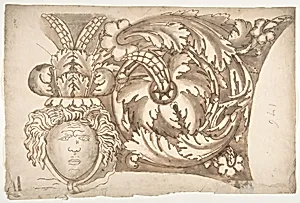
Arch of Septimius Severus, panel, elevation (recto) blank (verso)
early to mid-16th century
Medium
Dark brown ink, black chalk, and incised lines
Dimensions
sheet: 11 9/16 x 17 1/4 in. (29.3 x 43.8 cm)
Classification
Drawings|Ornament & Architecture
Department
Drawings and Prints
Museum
Metropolitan Museum of Art, New York, NY
Credit
Purchase, Rogers Fund, Joseph Pulitzer Bequest, and Mark J. Millard Gift, 1968
Accession Number
68.769.46
Rights
Public Domain
Tags
Art Historical Context
This exquisite 16th-century French captures the detailed elevation of a panel from Rome's Arch of Septimius Severus a grand triumphal arch erected around 203 CE to celebrate the emperor's victories. Created anonymously by a skilled draftsman—likely an architect or ornamentalist—the recto side meticulously renders the arch's ornate sculptural reliefs, while the verso blank. Executed in dark brown ink, black, and incised lines a sheet measuring 11 9/16 x 17 1/4 inches, it exemplifies Renaissance precision in studying classical antiquity. During the early to mid-16th century, French artists flocked to Italy, fueled by a humanist passion for rediscovering Roman architecture. Such drawings served practical purposes: incised lines allowed tracing or transfer onto other surfaces, aiding architects like those influenced by Sebastiano Serlio in replicating motifs for palaces, fountains, and decorative schemes. This piece reflects the era's "ornament & architecture" obsession, blending measurement with artistic flourish to revive ancient grandeur amid the French Renaissance. Housed in the Metropolitan Museum of Art's Drawings and Prints department (acquired in 1968), it offers a window into how 16th-century creators bridged antiquity and modernity, inspiring enduring motifs in Western design. A testament to meticulous craftsmanship, it invites us to trace the Arch's legacy from imperial Rome to Renaissance workshops.