
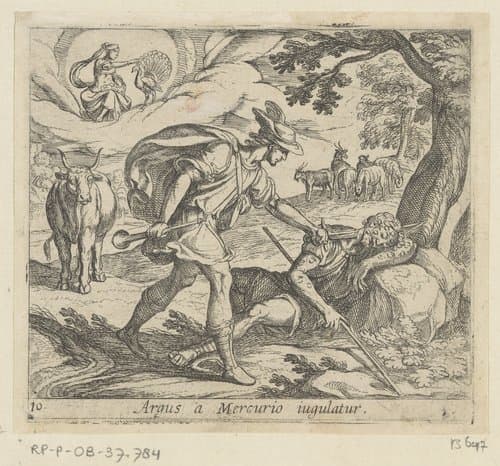
Argus a Mercurio iugulatur
1606
Medium
etching
Dimensions
104; 117
Rights
Public Domain
About this artwork
Mercurius snijdt met zijn zwaard het hoofd van de slapende Argus af. Juno zit met een pauw op wolken. In het landschap staan een os en een kudde bokken en schapen. Titel in het Latijn in ondermarge.
Art Historical Context
Step into the dramatic world of classical mythology with Antonio Tempesta's etching *Argus a Mercuriougulatur* (1606), a masterful depiction of a pivotal moment from Ovid's *amorphoses*. Tempesta, a prolific Italian artist of the late Mannerist period, was renowned for his intricate etchings that brought ancient tales to life through dynamic compositions and lively details. This small-scale print (104mm x 117mm) captures Mercury stealthily decapitating the sleeping giant Argus with his sword, fulfilling Jupiter's command to free the transformed Io from her watchful guard. In the foreground, Argus slumbers amid a pastoral landscape dotted with an ox—symbolizing Io—and flocks of goats and sheep from his herd. Above, Juno presides on clouds with her sacred peacock, its feathers echoing Argus's legendary hundred eyes, a poignant nod to the myth's tragic irony. The Latin title in the lower margin underscores the print's scholarly appeal, typical of Tempesta's series illustrating Ovid's epic. Etching allowed Tempesta to achieve fine lines and rich tonal contrasts, making this intimate work ideal for collectors in early 17th-century Europe. It reflects the era's fascination with classical antiquity, blending narrative drama with naturalistic animal studies, Tempesta's specialty, and inviting viewers to ponder themes of divine jealousy and mortal vulnerability.
About the Artist
Antonio Tempesta · 1555–1630
Antonio Tempesta (1555–1630), known as 'Il Tempestino,' was a Florentine painter and printmaker whose extraordinary output of approximately 1,700 etchings made him one of the most influential printmakers of the early Baroque period. Born in Florence and trained under Santi di Tito and the Flemish master Joannes Stradanus, he enrolled in the Accademia del Disegno in 1576 before relocating to Rome i...