
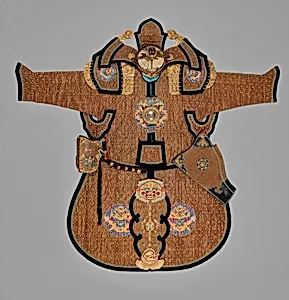
Armor with Archery Equipment and Box
Unknown Artist
ca. 1840
Medium
Textile (silk), copper alloy, steel, gold, silver, wood, leather, lacquer, paper, pigment
Classification
Armor for Man
Culture
Chinese
Department
Arms and Armor
Museum
Metropolitan Museum of Art, New York, NY
Credit
Bequest of George C. Stone, 1935
Accession Number
36.25.4a–t
Rights
Public Domain
Art Historical Context
This exquisite "Armor with Archery Equipment and Box crafted around 1840 during China's Qing Dynasty, showcases the pinnacle of late imperial arms and armor craftsmanship. Attributed to an unknown artist, the ensemble for a male warrior integrates functional protection with opulent decoration, using a rich array of materials: silk textiles for flexible elements, steel and copper alloy for durable plating, and lavish accents of gold, silver,quer, wood, leather paper, and pigment. Housed in the Metropolitan Museum of Art's Arms and Armor Department (Bequest of George C. Stone, 1935), it reflects the era's blend of military tradition and artistic refinement. Historically, this armor arrives at a transitional moment in Chinese warfare, as firearms gained prominence amid the Opium Wars, yet traditional archery—rooted in Confucian ideals as one of the "Six Arts"—remained a symbol of martial prowess and elite status. The included archery gear and storage box underscore its completeness, likely intended for a high-ranking officer or ceremonial use, highlighting China's enduring emphasis on the bow as a weapon of precision and honor. Artistically, the piece exemplifies Qing decorative techniques, with lacquer providing a glossy, protective sheen and metallic inlays adding symbolic motifs of power and longevity. Its multi-material construction not only ensured mobility and strength but also elevated armor from mere utility to a wearable work of art, embodying the cultural fusion of defense, aesthetics, and imperial prestige.