
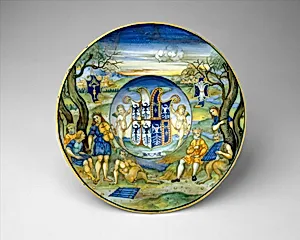
Armorial Plate (tondino): The story of King Midas
ca. 1520–25
Medium
Maiolica (tin-glazed earthenware)
Dimensions
Diam. 10 13/16 in. (27.5 cm)
Classification
Ceramics-Pottery
Department
Robert Lehman Collection
Museum
Metropolitan Museum of Art, New York, NY
Credit
Robert Lehman Collection, 1975
Accession Number
1975.1.1019
Rights
Public Domain
Tags
Art Historical Context
This exquisite armorial plate, crafted by the renowned maiolica artist Nicola da Urbino around1520–25, hails from the vibrant workshops of Renaissance Urbino, Italy—a hub of ceramic innovation. Measuring nearly 11 inches in diameter, this tin-glazed earthenwaretondino* (a shallow dish) showcases Nicola's mastery in blending utility with opulent decoration. Maiolica's signature technique involved firing earthenware coated in opaque white tin glaze, then applying brilliant mineral colors over it for a second firing, yielding jewel-like hues and fine details that made these pieces coveted across Europe. At its center unfolds the mythological tale of King Midas, depicted amid Apollo, satyrs, musicians, and musical instruments in a lively narrative scene. Midas, famously cursed with donkey ears for preferring the satyr Pan's pipes over Apollo's lyre in a contest, embodies themes of hubris and folly from classical lore, revived during the Renaissance humanist revival. The inclusion of a coat of arms suggests it was a bespoke commission for a noble patron, highlighting maiolica's role in displaying wealth and erudition at banquets. Part of the Robert Lehman Collection at The Metropolitan Museum of Art, this plate exemplifies Urbino's "istoriato" style—storytelling ceramics that elevated everyday objects to high art, influencing decorative arts for centuries. A true Renaissance gem!