
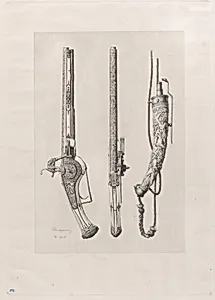
Arms of the XVIth Century
Medium
Etching, second state of three (Gonse)
Dimensions
Sheet: 17 5/16 × 12 1/8 in. (44 × 30.8 cm) Plate: 11 5/8 × 8 1/16 in. (29.5 × 20.5 cm)
Classification
Prints
Department
Drawings and Prints
Museum
Metropolitan Museum of Art, New York, NY
Credit
Gift of Louis R. Metcalfe, 1928
Accession Number
28.57.1
Rights
Public Domain
Tags
Art Historical Context
**Arms of the XVIth** is a masterful etching by French artist Jules-Ferdinandemart, created in 1865. Jacquemart, renowned for his meticulous reproductions of historical artifacts, captures the intricate details of 16th firearms in this print from the second state of three, as cataloged by the scholar Gonse. Measuring 17 5/16 × 12 1/8 inches on the sheet, it showcases his skill in rendering metalwork, ornamentation, and mechanical precision with astonishing clarity. This artwork reflects a 19th-century fascination with Renaissance arms and armor, a period when European gunsmiths pioneered innovative firearms amid the wars of religion and exploration. Jacquemart's etching preserves these artifacts' historical significance—symbols of technological advancement and craftsmanship from the 1500s—for modern audiences. As part of the Metropolitan Museum of Art's Drawings and Prints collection, gifted by Louis R. Metcalfe in 1928, it highlights etching's power as a medium for scholarly documentation. Visitors will appreciate how Jacquemart's fine lines and tonal variations evoke the gleam of polished steel and engraved decoration, bridging centuries of martial history in a single, elegant plate. A testament to precision printmaking!
About the Artist
Jules-Ferdinand Jacquemart · 1837–1880
**Jules-Ferdinand Jacquemart: Master Etcher and Watercolorist** Jules-Ferdinand Jacquemart was born on September 7, 1837, in Paris to Albert Jacquemart, a prominent art collector, ceramics historian, and amateur artist, and Louise Émilie Labbé. The third of four children, he received his initial training in etching from his father, who had no formal master himself and emphasized self-taught preci...