
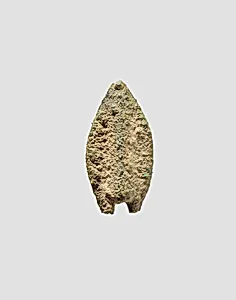
Arrowhead
Unknown Artist
ca. 1st century BCE–1st century CE
Medium
Bronze
Dimensions
0.24 x 0.47 x 0.94 in. (0.61 x 1.19 x 2.39 cm)
Classification
Metalwork-Implements
Culture & Period
Parthian · Parthian
Department
Ancient Near Eastern Art
Museum
Metropolitan Museum of Art, New York, NY
Credit
Purchase, H. Dunscombe Colt Gift, 1978
Accession Number
1978.93.56
Rights
Public Domain
Art Historical Context
This delicate bronze arrowhead crafted by an unknown Parian artisan around the 1st century BCE to1st century CE, a glimpse into the martial of the Parthian Empire, a that stretched across ancient Iran and Mesopotamia. Measuring just under an inch in length (0.94 in.), its compact size—0.24 x 0.47 x 0.94 in.—was ideal for the powerful composite bows wielded by Parthian archers, whose hit-and-run tactics famously confounded Roman legions, as seen in battles like Carrhae in 53 BCE. As a prime example of Parthian metalwork, this implement highlights the era's advanced bronze-casting techniques, likely involving lost-wax methods to achieve its precise, aerodynamic form. Arrowheads like this were essential tools of warfare and hunting, reflecting a culture where skilled craftsmanship supported a nomadic warrior elite. Though small, it embodies the Parthians' ingenuity in blending utility with durability. Acquired by the Metropolitan Museum of Art in 1978 through the H. Dunscombe Colt Gift, this artifact invites us to ponder the lives of ancient innovators whose everyday objects shaped empires.