
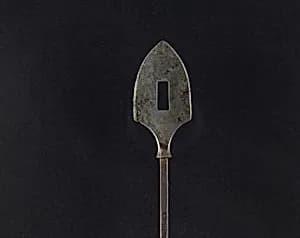
Arrowhead (<i>Yanone</i>)
Unknown Artist
18th century
Medium
Steel
Dimensions
L. 10 1/8 in. (25.7 cm); L. of head 2 1/2 in. (6.4 cm); W. 1 1/4 in. (3.2 cm); Wt. 0.9 oz. (25.5 g)
Classification
Archery Equipment-Arrowheads
Culture
Japanese
Department
Arms and Armor
Museum
Metropolitan Museum of Art, New York, NY
Credit
The Collection of Giovanni P. Morosini, presented by his daughter Giulia, 1932
Accession Number
32.75.395
Rights
Public Domain
Art Historical Context
Behold the exquisite *Yanone*, or arrowhead, a masterful example of 18th-century Japanese steel craftsmanship from the Metropolitan Museum Art's Arms and Armor. Measuring 10 1/8 inches (25.7 cm) in total, with a head of 2 1/2 inches (6.4 cm) long, 1 1/4 inches (3.2 cm) wide, and weighing a mere 0.9 ounces (25.5 g), this lightweight yet robust piece exemplifies the precision engineering required for effective archery. Forged from high-quality steel, its form balances aerodynamics and lethality, essential for piercing armor or game. In Edo-period Japan (1603–1868), archery—known as *kyūdō*—held profound cultural and martial significance, evolving from samurai warfare into a disciplined art form. *Yanone* like this one varied in design for hunting, battle, or ceremonial use, showcasing the metallurgical expertise of anonymous Japanese smiths who folded and hammered steel to achieve exceptional sharpness and durability. Though the artist remains unknown, the arrowhead's refined proportions reflect centuries of tradition in weaponsmithing. A generous gift from the Giovanni P. Morosini Collection in 1932, this *Yanone* invites visitors to appreciate the artistry in functional objects, where beauty meets utility in Japan's storied warrior heritage.