
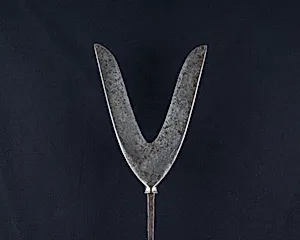
Arrowhead (<i>Yanone</i>)
Unknown Artist
18th century
Medium
Steel
Dimensions
L. 17 1/4 in. (43.8 cm); L. of head 5 5/8 in. (14.3 cm); W. 4 5/16 in. (11 cm); Wt. 5.3 oz. (150.3 g)
Classification
Archery Equipment-Arrowheads
Culture
Japanese
Department
Arms and Armor
Museum
Metropolitan Museum of Art, New York, NY
Credit
The Collection of Giovanni P. Morosini, presented by his daughter Giulia, 1932
Accession Number
32.75.500
Rights
Public Domain
Art Historical Context
This exquisite 18th-century Japanese arrowhead, known as a *yanone*, showcases the masterful steel craftsmanship of Edo-period artisans. Measuring 17¼ inches in total length, with a head of 5⅝ inches long and 4⅜ inches wide, it weighs a precise 5.3 ounces—dimensions that reflect careful design for balance, penetration, and flight stability. Forged from high-quality steel, such arrowheads were essential components of archery equipment, blending lethal functionality with refined metallurgy techniques honed over centuries. In Japanese culture, archery (*kyūdō*) held profound historical and symbolic importance, rooted in samurai traditions and Zen philosophy. During the 18th century, a time of relative peace under the Tokugawa shogunate, *yanone* like this one were used in warfare, hunting, or ceremonial practices, often customized in shape for specific purposes such as armor-piercing or whistling in flight. Their creation demanded exceptional skill in folding and tempering steel to achieve razor-sharp edges and durability. Housed in the Metropolitan Museum of Art's Arms and Armor Department, this piece entered the collection in 1932 as part of Giovanni P. Morosini's gift, presented by his daughter Giulia. It invites visitors to appreciate how Japanese arms transformed everyday weapons into objects of artistry, revealing the intersection of utility, culture, and technical prowess.