
Arrowhead (<i>Yanone</i>)
Unknown Artist
18th century
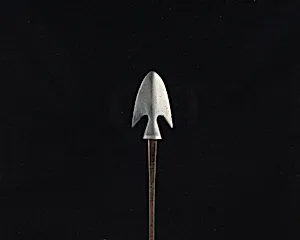
Medium
Steel
Dimensions
L. 4 3/8 in. (11.1 cm); L. of head 1 1/4 in. (3.2 cm); W. 3/4 in. (1.9 cm); Wt. 0.4 oz. (11.3 g)
Classification
Archery Equipment-Arrowheads
Culture
Japanese
Department
Arms and Armor
Museum
Metropolitan Museum of Art, New York, NY
Credit
The Collection of Giovanni P. Morosini, presented by his daughter Giulia, 1932
Accession Number
32.75.690
Rights
Public Domain
Art Historical Context
This exquisite steel arrowhead, known as *yanone* in Japanese, hails from 18th-century Japan and exemplifies the masterful craftsmanship of the Edo period. Measuring just 4 3/8 inches in total length with a compact head of 1 1/4 inches, its slender form and lightweight 0.4 ounces made it ideal for archery, a skill central to samurai culture and warfare. Forged from high-quality steel, the arrowhead's precise dimensions—1 3/4 inches wide—reflect advanced metallurgical techniques honed over centuries, balancing aerodynamics with lethal penetration. In Japanese history, archery was not merely martial but a revered art form, symbolizing discipline and precision. *Yanone* like this one varied in design for hunting, combat, or even ceremonial use, underscoring Japan's fusion of utility and artistry in arms. Though the artist remains unknown, such pieces highlight anonymous artisans' skill in the arms trade, often producing tools that doubled as status symbols. Now housed in the Metropolitan Museum of Art's Arms and Armor Department, this artifact from Giovanni P. Morosini's collection (gifted in 1932) invites visitors to ponder the elegance of weaponry. Its survival offers a tangible link to feudal Japan's world of bushido and bow-wielding warriors.