
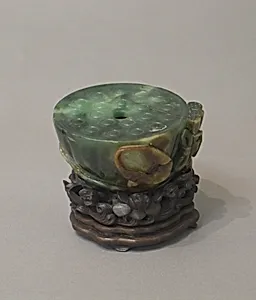
Artist's water holder
Unknown Artist
Medium
Jadeite, shades of green, varying from very light green to very dark bluish-green, with yellow and rich dead-oak-leaf
Dimensions
H. 2 in. (5.1 cm); W. 3 3/8 in. (8.5 cm)
Classification
Jade
Culture & Period
China · Qing dynasty (1644–1911), Kangxi period (1662–1722)
Department
Asian Art
Museum
Metropolitan Museum of Art, New York, NY
Credit
Gift of Heber R. Bishop, 1902
Accession Number
02.18.431
Rights
Public Domain
Art Historical Context
Nestled among the treasures of the Metropolitan Museum of Art's Asian Art collection, this delicate jadeite water holder, gifted by Heber R. Bishop in1902, exemplifies the refined artistry of China's Qing dynasty during the Kangxi period (2–1722). just 2 inches high and 3⅜ inches wide, its compact form belies its intricate beauty. Crafted fromite in mesmerizing shades—from pale green to deep bluish-green, accented by yellow and rich oak-leaf tones—the stone's natural variations are masterfully showcased, creating a lifelike, organic flow reminiscent of rippling water or lush foliage. In imperial China, jade carving reached new heights under the Kangxi emperor, a patron of the arts who favored nephrite and jadeite for scholar's objects. This "artist's water holder," or *shui zhi*, was essential for literati painters and calligraphers, dispensing water to grind ink on stones for flawless brushwork. Artisans employed precise techniques to hollow the interior while preserving the jade's translucency and veining, transforming a functional tool into a symbol of elegance and harmony with nature. Such pieces highlight jade's enduring cultural reverence in China as a material of purity and immortality, bridging utility and aesthetics in daily scholarly rituals. A testament to Kangxi-era virtuosity, it invites visitors to appreciate the subtle interplay of color and form in one of Asia's most treasured crafts.