
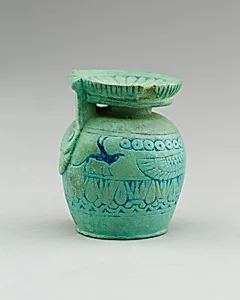
Aryballos
Unknown Artist
550–500 B.C.
Medium
Faience
Dimensions
H. 6.3 cm (2 1/2 in)
Classification
Aryballos
Period
Late Period
Department
Egyptian Art
Museum
Metropolitan Museum of Art, New York, NY
Credit
Gift of J. Pierpont Morgan, 1917
Accession Number
17.194.2281
Rights
Public Domain
Art Historical Context
This delicate *aryballos*, a small spherical vessel with a narrow neck, hails from Egypt's Late Period (550–500 B.C.), during Dynasties 26–27. Crafted from faience—a prized glazed ceramic made from quartz paste that mimics the vibrant blues of lapis lazuli or turquoise—it stands just 6.3 cm tall, perfect for holding precious oils, perfumes, or cosmetics. Donated to the Metropolitan Museum of Art in 1917 by J. Pierpont Morgan, it exemplifies the exquisite craftsmanship of this era. The Late Period marked a renaissance in Egyptian art, blending traditional techniques with influences from Mediterranean trade, including Greek styles—hence the aryballos form, popular in the Aegean world. Faience production involved molding the paste, applying a copper-based glaze, and firing it to create a glossy, jewel-like sheen, symbolizing eternity and the divine Nile. These vessels were everyday luxuries for the elite, often used in rituals or personal grooming. Though the artist remains unknown, this piece highlights faience's cultural prestige: lightweight, durable, and colorful, it bridged utility and artistry in a time of political flux under Saite and early Persian rule. A tiny treasure revealing ancient Egypt's sophisticated world!