
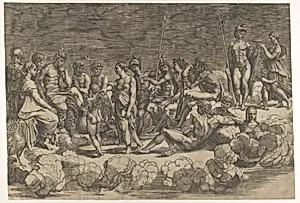
Assembly of the Gods after the ceiling composition in the Loggia di Psiche, Villa Farnesina, Rome
Medium
Engraving; first state of two
Dimensions
Sheet (Trimmed): 14 3/4 × 21 7/16 in. (37.4 × 54.5 cm)
Classification
Prints
Department
Drawings and Prints
Museum
Metropolitan Museum of Art, New York, NY
Credit
The Elisha Whittelsey Collection, The Elisha Whittelsey Fund, 1949
Accession Number
49.97.249
Rights
Public Domain
Tags
Art Historical Context
This exquisite engraving, titled *Assembly of the Gods after ceiling composition in the Log di Psiche, Villa Farnesina, Rome captures the High Renaissance grandeur of Raphael's, faithfully reproduced by engravers Giovanni Jacopo Caraglio and Giovanni Penni in 1527. The first state of two impressions, it depicts a mythological gathering featuring male and female nudes, Cupid, Psyche, and peacocksevoking the Roman gods in a lively, harmonious tableau inspired by the frescoed ceiling of Rome's Villa Farnesina. Raphael (Raffaello Sanzio), the design mastermind, infused the scene with his signature grace, ideal proportions, and dynamic compositions drawn from classical antiquity. Created just a decade after Raphael and his workshop adorned banker Agostino Chigi's opulent villa (ca. 1517–18), this print played a pivotal role in disseminating Renaissance artistry beyond elite patrons. Engravings like this allowed collectors across Europe to own affordable replicas of frescoes, preserving and popularizing Raphael's innovative fusion of pagan mythology—from Apuleius's tale of Cupid and Psyche—with humanist ideals of beauty and harmony. Measuring 14¾ × 21½ inches, its intricate lines showcase the engravers' skill in translating Raphael's vibrant colors into monochromatic depth, highlighting the era's technical mastery in printmaking. At the Metropolitan Museum of Art, this rare first-state work from The Elisha Whittelsey Collection invites visitors to marvel at how prints bridged art and culture, making divine assemblies accessible to all.
About the Artist
Giovanni Jacopo Caraglio|Giovanni Francesco Penni|Raphael (Raffaello Sanzio or Santi) · 1500–1565
Italian, Parma or Verona ca. 1500/1505–1565 Krakow (?)