
Astronomical Ceiling
ca. 1479–1458 B.C.
Medium
Tempera on paper
Dimensions
Facsimile: H. 73 × W. 56.5 cm (28 3/4 × 22 1/4 in.); scale approximately 1:5;, Framed: H. 74.6 × W. 58.1 cm (29 3/8 × 22 7/8 in.)
Classification
Facsimile, Senenmut (TT 353), astronomical ceiling
Period
Original: New Kingdom
Department
Egyptian Art
Museum
Metropolitan Museum of Art, New York, NY
Credit
Rogers Fund, 1948
Accession Number
48.105.52
Rights
Public Domain
Tags
Art Historical Context
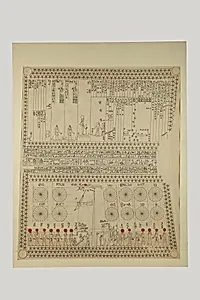
Behold the *Astronomical Ceiling*, mesmerizing facsimile crafted by Charles K. Wilkinson ina on paper, faithfully reproducing an ancient Egyptian masterpiece from the New Kingdom's Dynasty 18 (ca. 1479–1458 B.C.). This recreation captures the celestial panorama of a tomb ceiling, likely from a royal burial site, where Egyptians mapped the night sky with remarkable precision. Adorned with hieroglyphs and astronomical motifs, it showcases star clocks, decans—groups of stars used to track hours—and deities personifying cosmic order. In ancient Egypt, such ceilings held profound cultural and religious significance, symbolizing the pharaoh's eternal journey through the afterlife alongside the sun god Re. Crafted during the height of Dynasty 18's imperial power—under rulers like Hatshepsut and Thutmose III—these depictions reveal sophisticated astronomical knowledge integral to calendars, agriculture, and rituals. The use of vivid colors and symbolic hieroglyphs blended art, science, and mythology, affirming the Egyptians' view of a harmonious universe governed by divine cycles. Today, this 1:5 scale replica at the Metropolitan Museum of Art invites visitors to gaze upon the ancients' starry realm, bridging millennia. Acquired through the Rogers Fund in 1948, it highlights how Egyptian art transformed stone tombs into portals of eternity, blending technical mastery with spiritual awe.
About the Artist
Charles K. Wilkinson · 1897–1986
Charles K. Wilkinson (1897–1986), born Charles Kyrle Wilkinson in London on October 13, 1897, was the son of Horace W. Wilkinson, a stained-glass window maker, and Frances Adkins. Serving in World War I, he honed his artistic skills at the Slade School of Fine Art, University College London, where the influential director Henry Tonks shaped the rigorous training of a generation of draughtsmen. In ...