
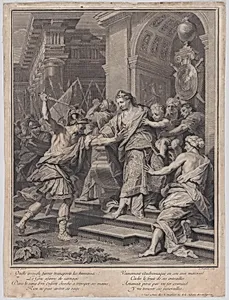
Astyanax taken from Andromache
Medium
Engraving
Dimensions
Image: 16 1/8 × 12 15/16 in. (41 × 32.9 cm) Sheet: 18 5/16 × 13 3/4 in. (46.5 × 34.9 cm)
Classification
Prints
Department
Drawings and Prints
Museum
Metropolitan Museum of Art, New York, NY
Credit
Gift of Mrs. Olga Sichel and Max Philippson, 1962
Accession Number
62.557.95
Rights
Public Domain
Art Historical Context
In the poignant engraving *Astyanax Taken from Andromache*, between 1700 and 1739, French artist Jean-Baptiste Jouet captures a heart-wrenching moment from mythology. The scene depicts the Trojan prince Astyanax, infant son of Hector and Andache, being seized from his mother's arms during the fall of Troy—a tragic episode drawn from Homer's *Iliad* and Virgil's *Aeneid*. Jouvenet, a leading history painter of the late Baroque era, designed the composition, while engraver Louis Desplaces masterfully translated it into print, emphasizing emotional intensity through dynamic poses and expressive faces. Engravings like this one were revolutionary in the early 18th century, allowing grand paintings to reach wider audiences beyond elite patrons. Desplaces's precise burin work on copper plates produces rich tonal contrasts and intricate details, from Andromache's despairing gesture to the soldiers' grim resolve, making the image both intimate and monumental. Measuring 16 1/8 × 12 15/16 inches, this sheet reflects the era's fascination with classical antiquity amid France's opulent ancien régime. Today, housed in the Metropolitan Museum of Art's Drawings and Prints department as a 1962 gift from Mrs. Olga Sichel and Max Philippson, it exemplifies how prints preserved and popularized mythological narratives, bridging art and literature for generations of viewers.