
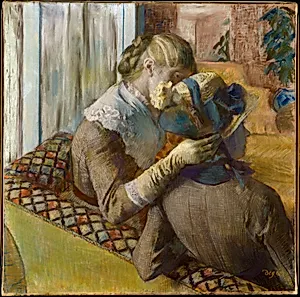
At the Milliner's
1881
Medium
Pastel on five pieces of wove paper, backed with paper, and laid down on canvas
Dimensions
27 1/4 x 27 1/4 in. (69.2 x 69.2 cm)
Classification
Pastels & Oil Sketches on Paper
Department
European Paintings
Museum
Metropolitan Museum of Art, New York, NY
Credit
The Walter H. and Leonore Annenberg Collection, Gift of Walter H. and Leonore Annenberg, 1997, Bequest of Walter H. Annenberg, 2002
Accession Number
1997.391.1
Rights
Public Domain
Tags
Art Historical Context
In Edgar Degas' *At the Milliner's* (1881), a poised woman examines a hat in the intimate confines of a milliner's shop, capturing a fleeting moment of everyday Parisian life. Degas, a leading figure in the Impressionist movement, often turned his gaze to modern women in private or professional settings—ballet dancers, laundresses, and now a milliner's client—revealing their grace and individuality amid the bustle of 19th-century France. This square-format work, measuring 27¼ × 27¼ inches, evokes the poised elegance of fashion houses, where elaborate hats were essential accessories for women of the era. Degas' mastery of pastel shines here, applied to five pieces of wove paper meticulously backed and laid on canvas to create a monumental scale unusual for the medium. Pastel allowed him to achieve vibrant, luminous effects with layered colors and soft blending, emphasizing texture—from the hat's delicate fabrics to the subtle play of light on skin and garments. This technical innovation highlights Degas' shift from oils to pastels in his later career, pushing the boundaries of drawing toward painting. Housed in the Metropolitan Museum of Art as part of the Annenberg Collection, *At the Milliner's* exemplifies Degas' fascination with female modernity and craftsmanship. It invites viewers to linger on the quiet drama of choice and adornment, a cultural snapshot of Belle Époque femininity.
About the Artist
Edgar Degas · 1834–1917
Edgar Degas (1834-1917) stands as one of the most innovative artists of the nineteenth century, whose distinctive vision transformed how modern life could be depicted on canvas. Born Hilaire-Germain-Edgar De Gas in Paris to a wealthy banking family—his father French, his mother a Louisiana Creole from New Orleans—Degas received a classical education before abandoning law studies in 1855 to pursue ...