
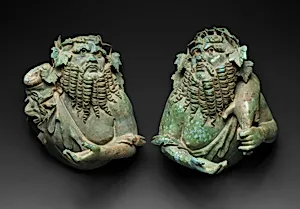
Attachments Depicting Busts of Silenoi
Mid 1st century BCE-mid 1st century CE
Medium
Bronze, silver, and copper
Dimensions
1: 17.8 × 14.6 × 8.6 cm (7 × 5 3/4 × 3 3/8 in.); 2: 18.7 × 16.2 × 8.9 cm (7 3/8 × 6 3/8 × 4 1/2 in.)
Classification
sculpture
Department
Arts of Greece, Rome, and Byzantium
Museum
Art Institute of Chicago
Accession Number
147877
Rights
Public Domain
About this artwork
The Greek imagination was populated with a number of strange creatures. When their thoughts turned to wine, Greeks pictured mischievous young satyrs, the half- human, half-horse creatures who frolicked, danced, and chased hapless maenads. Satyrs symbolized suppressed hedonistic desires that were unleashed by the intoxicating elixir of the wine god Dionysos, known to the Romans as Bacchus. These creatures are mature satyrs, or silenoi (sing. silenos), and they once served as decorative elements f...
About the Artist
Ancient Roman
The artists attributed to "Ancient Roman" in museum collections represent the anonymous craftsmen who produced the vast output of sculpture, frescoes, mosaics, and reliefs defining Roman visual culture from the Republic (c. 509–27 BCE) to the late Empire (c. 395 CE). Individual identities remain elusive, as Roman makers were typically viewed as skilled tradesmen—often enslaved Greeks or provincial...