
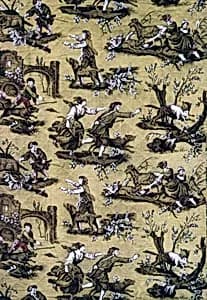
Au Loup! (Furnishing Fabric)
1783/89
Medium
Cotton, plain weave; copperplate printed
Dimensions
93 × 136 cm (36 5/8 × 53 1/2 in.)
Classification
textile
Department
Textiles
Museum
Art Institute of Chicago
Accession Number
60689
Rights
Public Domain
Art Historical Context
Step into the elegant world of 18th-century French interiors with *Au Loup! (Furnishing Fabric)*, vibrant cotton panel designed by Jean Baptiste Hu between 1783 and 1789. Huet, a master of Rococo style with its playful pastoral scenes, crafted this piece for luxurious home furnishings. Measuring 93 × 136 cm, it's a prime example of printed textiles from the Art Institute of Chicago's Textiles, evoking the charm of rural French life just before the Revolution. Printed using innovative copperplate techniques on plain-weave cotton, *Au Loup!*—translating to "To the Wolf!"—showcases Huet's signature lively depictions of animals and Arcadian vignettes. Copperplate printing, pioneered at factories like Jouy-en-Josas, allowed for intricate, multi-color designs that mimicked expensive hand-painted silks, making opulent patterns accessible to the bourgeoisie. This medium revolutionized decorative arts, blending artistry with industrial precision. Culturally, such fabrics adorned walls and upholstery in chateaus and salons, symbolizing refined taste amid Enlightenment ideals of nature's harmony. Huet's whimsical wolf chase captures the era's delight in fables and fantasy, inviting visitors to imagine the laughter and leisure of pre-Revolutionary France. A textile treasure indeed! (198 words)
About the Artist
Jean Baptiste Huet · 1745–1811
Jean-Baptiste Marie Huet (1745–1811) was born into a family of artists in Paris on October 15, 1745. The son of animal painter Nicolas Huet the Elder, with whom he first trained, Huet was also the nephew of the renowned sculptor and decorator Christophe Huet. He apprenticed under animal painter Charles Dagomer, a member of the Académie de Saint-Luc, during the 1760s, honing his skills in depicting...