
Auguste Barre
ca. 1880
Medium
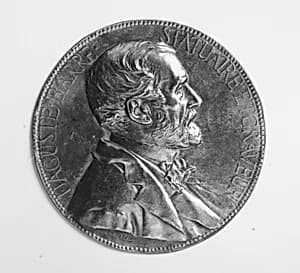
Silvered bronze uniface medal
Dimensions
Diam. 132 mm.
Classification
Medals and Plaquettes
Culture
French
Department
European Sculpture and Decorative Arts
Museum
Metropolitan Museum of Art, New York, NY
Credit
Gift of Dr. and Mrs. Michael Schlossberg, 2001
Accession Number
2001.772
Rights
Public Domain
Tags
Art Historical Context
This striking silvered bronze uniface, titled *Auguste Barre* and created by the renowned French engraver Jules-Clément Chap around 1880, honors its namesake through a detailed profile portrait. Measuring an impressive 132 mm in diameter—more akin to a plaquette than typical pocket medal—it showcases Chaplain's mastery of low-relief sculpture. The uniface design, featuring imagery on one side only, highlights the subject's dignified profile, evoking classical Roman coinage while rooted in 19th-century French tradition. Chaplain (1839–1909), chief engraver at the Paris Mint and a leading figure in the revival of medal art during France's Third Republic, elevated the medium from mere currency to fine art. His works often commemorated notable figures in politics, arts, and sciences, blending Realism's precise anatomy with subtle Art Nouveau flourishes. This piece reflects that era's fascination with portraiture as a form of personal and cultural tribute, common among Europe's elite collectors. Housed in the Metropolitan Museum of Art's European Sculpture and Decorative Arts department (gift of Dr. and Mrs. Michael Schlossberg, 2001), the medal's silvery patina enhances its luminous quality, inviting viewers to appreciate the tactile elegance of bronze casting and chasing techniques. A testament to Franco medalcraft's golden age, it bridges historical reverence with artistic innovation.
About the Artist
Jules-Clément Chaplain · 1839–1909
Jules-Clément Chaplain (1839–1909) was a French engraver and medallist who became the most celebrated practitioner of the art medal in late nineteenth-century France. Born in Mortagne-au-Perche in Normandy, he studied at the École des Beaux-Arts in Paris under Jouffroy and Oudiné and won the Prix de Rome for engraving in 1863, which enabled him to study in Italy for several years. Chaplain's work...