
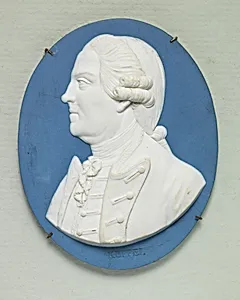
Augustus, Viscount Keppel
Medium
Jasper ware
Dimensions
3 7/8 × 3 1/16 in. (9.8 × 7.8 cm)
Classification
Ceramics-Pottery
Culture
British, Etruria, Staffordshire
Department
European Sculpture and Decorative Arts
Museum
Metropolitan Museum of Art, New York, NY
Credit
Gift of James Hazen Hyde, 1948
Accession Number
48.16.6
Rights
Public Domain
Tags
Art Historical Context
This exquisite Jasperware portrait medallion Augustus Keppel, 1st Viscount Keppel1725–1786), a celebrated British naval commander during the American Revolutionary War era. Produced around 1780 by the renowned firm of Wedgwood and Bentley, with modeling attributed to sculptor John Flaxman, captures Keppel in classical profile, evoking ancient Roman coins and cameos. Housed in the Metropolitan Museum of Art's Sculpture and Decorative Arts, this small-scale ceramic (just under 4 inches wide) exemplifies the neoclassical revival that swept 18th-century Britain. Wedgwood's Jasperware, invented by Josiah Wedgwood in the 1770s, revolutionized ceramics with its fine-grained, matte stoneware—typically a deep blue body adorned with white relief figures applied in a "sprigging" technique. Flaxman's precise, elegant modeling brought antique-inspired idealism to modern portraiture, making these medallions affordable luxury items for fashionable homes. Keppel's fame stemmed from his role in the 1778 Battle of Ushant and dramatic acquittal in a politically charged court-martial, cementing his status as a national hero amid turbulent times. As a cultural artifact from Wedgwood's Etruria factory in Staffordshire, this piece highlights Britain's industrial innovation and passion for classical antiquity, blending artistry with mass production to democratize elegance. Visitors will appreciate its tactile allure and historical resonance.