
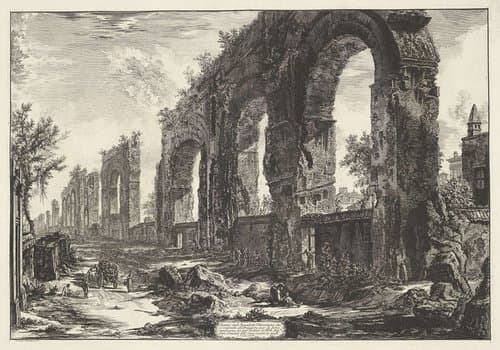
Avanzi degl'Aquedotti Neroniani che si volevano distruggere per la loro vecchiezza (...)
1748 - 1778
Medium
etching
Dimensions
490; 710
Rights
Public Domain
About this artwork
height 490 mm x width 710 mm
Art Historical Context
Giovanni Battista Piranesi, the visionary 18th-century Italian and architect, immortalized Rome's ancient grandeur in his masterful etchings. *Avanzi degl'Aquedotti Neroniani si volevano distrugg per la loro vecchie* (Remains of the Neron Aqueducts That Were to Be Destroyed Due to Their Age), created between 1748 and1778, depicts the weathered ruins of aqueducts built under Emperor Nero in the 1st century AD. Part of Piranesi's renowned *Vedute di Roma* series, this large-scale etching (490 × 710 mm) captures a moment of historical tension: these vital engineering marvels, symbols of Roman ingenuity, faced demolition for being "too old," highlighting the era's neglect of antiquity amid urban expansion. Piranesi's work transcends mere documentation; it passionately advocates for preservation, blending archaeological accuracy with dramatic romanticism. His vedute style—part of the broader movement celebrating Rome's ruins—influenced Neoclassicism and tourists alike, turning decayed structures into sublime monuments of human achievement. The aqueducts, once channeling water across miles to feed the Eternal City, evoke the empire's lost glory and engineering prowess. Rendered in etching, Piranesi's technique shines through intricate cross-hatching and deep shadows, creating a textured, atmospheric depth that draws viewers into the scene. This monumental print invites us to ponder endurance: what we discard as obsolete may hold timeless lessons.
About the Artist
Giovanni Battista Piranesi · 1720–1778
Giovanni Battista Piranesi (1720–1778) was an Italian printmaker, architect, and antiquarian whose visionary etchings of Rome and imaginary prisons revolutionized architectural representation and profoundly influenced both Neoclassicism and Romanticism. Piranesi stands as one of the most important printmakers of the eighteenth century, fundamentally shaping European perceptions of ancient Rome an...