
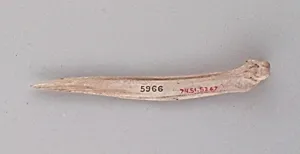
Awl
Unknown Artist
Medium
Fish bone
Dimensions
Other: 1/2 x 3 1/8 in. (1.3 x 8 cm)
Classification
Miscellaneous-Bone, Ivory
Culture
Cypriot
Department
Greek and Roman Art
Museum
Metropolitan Museum of Art, New York, NY
Credit
The Cesnola Collection, Purchased by subscription, 1874–76
Accession Number
74.51.5267
Rights
Public Domain
Art Historical Context
This slender awl, crafted from a fish bone, exemplifies the ingenuity of ancient Cypriot artisans in transforming everyday natural materials into practical tools. Measuring just 1/2 x 3 1/8 inches (1.3 x 8 cm), its pointed tip and polished surface suggest careful shaping and smoothing, likely achieved through grinding and abrasion techniques common in prehistoric bone-working traditions. Fish bones, abundant on Cyprus's island shores, were a resourceful choice for such implements, highlighting the close ties between Cypriot life and the sea. Dating to an unknown period but rooted in Cypriot culture—part of the broader Greek and Roman artistic sphere—this awl would have served utilitarian purposes, such as piercing leather, weaving baskets, or working hides. It offers a glimpse into the daily craftsmanship of ancient Cyprus, a Mediterranean crossroads where trade and innovation flourished from the Bronze Age onward. Artifacts like this underscore how ordinary objects reveal much about a society's resourcefulness and technical skill. Acquired as part of The Cesnola Collection (purchased by subscription, 1874–76) and now housed in the Metropolitan Museum of Art's Greek and Roman Art Department, this unassuming tool reminds us that even the humblest relics preserve profound cultural stories. Visitors are invited to appreciate its tactile simplicity—a testament to human adaptability.