
Bacchanales
Medium
etching
Dimensions
211; 142
Rights
Public Domain
About this artwork
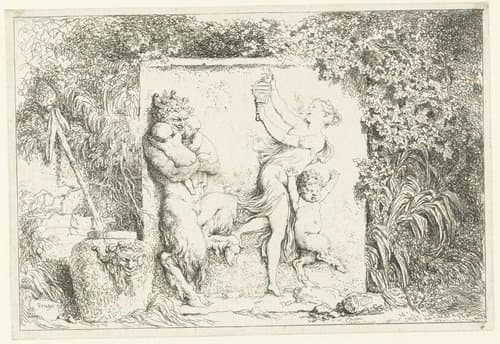
Een bas-reliëf, staand op de grond tussen planten, met een afbeelding van een dansende saterfamilie. De sater met twee kinderen op de arm, de nimf met een schellenraam en een kleine dansende sater met de armen omhoog.
Art Historical Context
**Bacchanales** (1763) is a delightful etching by Jean Honoréagonard, the quintessential French Rococo artist renowned for his playful, sensual depictions of mythological revelry. Measuring just 142 × 211 mm, this intimate print captures a bas-relief scene of a dancing satyr family amid lush plants: a satyr cradling two children, a nymph shaking a rattle (schellenraam), a small satyr with arms joyfully raised. Fragon Rococo style shines through in the exuberant movement and whimsical family dynamic, evoking the carefree spirit of ancient bacchanals—festive rites honoring Dionysus, god of wine and ecstasy. Etching allowed Fragonard to translate the sculptural depth of a bas-relief into fine lines and textures on a copper plate, etched with acid for precise, expressive detail. Created at the height of Rococo's ornate elegance in mid-18th-century France, before the shift to sober Neoclassicism, it reflects the era's fascination with pastoral idylls and erotic undertones, blending classical antiquity with lighthearted fantasy. This work invites visitors to revel in Fragonard's mastery of joy and fluidity, a window into Enlightenment-era escapism where even mythical creatures frolic like a happy family. A gem for print enthusiasts, it showcases how Rococo printmaking democratized elite art themes.
About the Artist
Jean Honoré Fragonard · 1732–1806
Jean-Honoré Fragonard (1732-1806) was a French painter and printmaker whose late Rococo manner was distinguished by remarkable facility, exuberance, and hedonism. Born in Grasse, he moved to Paris where he trained under Jean-Baptiste Chardin and François Boucher, winning the prestigious Prix de Rome in 1752. After studying in Italy alongside Hubert Robert, Fragonard returned to Paris in 1761 to fi...