
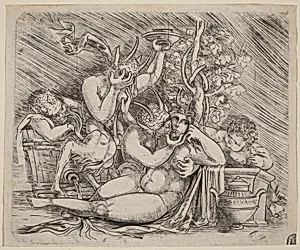
Bacchanalian Scene with Satyrs and a Maenad
c. 1515
Medium
engraving
Dimensions
sheet: 10.2 x 12.3 cm (4 x 4 13/16 in.)
Classification
Department
CG-E
Museum
National Gallery of Art, Washington, D.C.
Credit
Ailsa Mellon Bruce Fund
Accession Number
1966.5.1
Rights
Public Domain
Art Historical Context
In the lively *Bacchanalian Scene withyrs and a Maenad*, created around 1515 by the enigmatic Master of 1515, visitors are transported to a whirlwind of mythological revelry. This small engraving (10.2 x 12.3 cm) captures satyrs—half-human, half-goat followers of the wine god Bacchus—frolicking with a maenad, one of Dionysus's ecstatic female devotees. The scene brims with the chaotic energy of ancient Roman bacchanals, blending nudity, dance, and inebriation in a compact, intricate composition that reflects the Renaissance fascination with classical antiquity. As an engraving, a precise intaglio technique where lines are incised into a metal plate and inked for printing, this work exemplifies early 16th-century Northern European printmaking. The Master of 1515, an anonymous artist named for a dated work, specialized in such diminutive yet detailed prints, making sophisticated imagery accessible beyond elite paintings. Held in the National Gallery of Art's Prints department (acquired via the Ailsa Mellon Bruce Fund), it highlights how engravings democratized art, influencing collectors and artists across Europe. This piece invites us to ponder the cultural allure of bacchanalian themes: symbols of liberation and excess that bridged pagan myths with Christian-era humanism, offering a playful escape in an age of religious upheaval.