
Back Plate of a Belt Buckle
Unknown Artist
late 6th–7th century
Medium
Iron with silver inlay
Dimensions
Overall: 1 7/8 x 1/4 x 1 3/4 in. (4.7 x 0.7 x 4.5 cm)
Classification
Metalwork-Iron
Culture
Frankish
Department
Medieval Art
Museum
Metropolitan Museum of Art, New York, NY
Credit
Gift of J. Pierpont Morgan, 1917
Accession Number
17.193.99
Rights
Public Domain
Art Historical Context
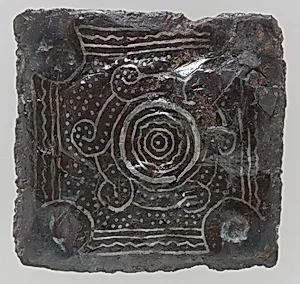
This delicate back plate from a belt buckle, crafted by an unknown Frankish artisan in the late 6th to 7th century, exemplifies refined metalworking of the early medieval Merovingian period. Measuring just under 2 inches across, it was forged from iron and adorned with silver inlay—a technique where thin silver wires or sheets were meticulously hammered into incised grooves on the iron surface, creating shimmering patterns that caught the light. Such contrasting materials highlighted the skill of Frankish craftsmen, blending sturdy functionality with subtle luxury. In Frankish society, belt buckles were more than practical accessories; they served as status symbols for warriors and elites, often buried with their owners to signify wealth and identity in the afterlife. This piece, part of the Metropolitan Museum of Art's Medieval Art collection (gift of J. Pierpont Morgan, 1917), reflects the cultural transitions of post-Roman Gaul, where Germanic tribes fused local traditions with emerging Christian influences. Its geometric or interlace designs, typical of the era, foreshadowed the intricate motifs of later Carolingian art. Though small, this artifact offers a tangible glimpse into daily life and artistry 1,400 years ago, reminding us how everyday objects carried profound social meaning.