
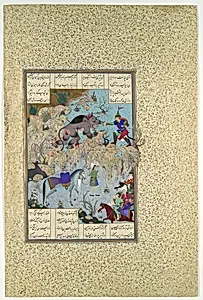
"Bahram Chubina Slays the Lion-Ape", Folio 715v from the Shahnama (Book of Kings) of Shah Tahmasp
Medium
Opaque watercolor, ink, silver, and gold on paper
Dimensions
Painting: H. 11 1/16 in. (28.1 cm) W. 7 3/4 in. (19.7 cm) Entire Page: H. 18 1/2 in. (47 cm) W. 11 3/16 in. (28.4 cm) Mat: H. 22 in. (55.9 cm) W. 16 in. (40.6 cm)
Classification
Codices
Department
Islamic Art
Museum
Metropolitan Museum of Art, New York, NY
Credit
Gift of Arthur A. Houghton Jr., 1970
Accession Number
1970.301.74
Rights
Public Domain
Tags
Art Historical Context
This stunning folio, "Bahram Chubinaays the Lion-Ape (Folio 715v), comes the magnificent *Shahnama* ( of Kings) of Shah Tahmasp the crowning achievement of Safavid Persian manuscript illumination around 1530–35. Created in the royal atelier of Tabriz under Shah Tahmasp I, this epic poem by Abu'l Qasim Firda recounts Iran's mythical kings and heroes. Here, the warrior Bahram Chubina a fearsome lion-ape hybrid—a dramatic episode blending heroism, bravery, and the supernatural perils faced by Persian champions. Masterfully painted by artists Mir Musavvir and Qasim ibn 'Ali, the scene bursts with the hallmarks of Safavid miniature style: intricate opaque watercolors, shimmering ink, silver, and gold on paper. Vibrant hues and fine gold detailing capture dynamic motion—the hero likely astride a rearing horse amid kings and men—within a compact yet immersive composition (painting: 11 1/16 x 7 3/4 in.). These techniques elevated Persian codices to pinnacles of Islamic art, blending narrative storytelling with jewel-like precision. Housed in the Metropolitan Museum of Art's Islamic Art Department (gift of Arthur A. Houghton Jr., 1970), this folio exemplifies the cultural prestige of the *Shahnama* as a symbol of Safavid power and Persian identity, inspiring generations with its timeless tales of valor.
About the Artist
Mir Musavvir|Qasim ibn 'Ali|Abu'l Qasim Firdausi (Iranian|Iranian|Iranian) · 1500 |0935 |1500 –1590 |1020 |1585
Iranian, active ca. 1525–1565|Iranian, Paj ca. 940/41–1020 Tus|Iranian, active ca. 1525–55