
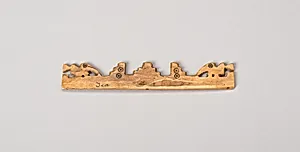
Balance-Beam Scale with Cut-Out Bird and Step Motifs
500–1400
Medium
Bone with pigment
Dimensions
14.1 × 2.4 cm (5 9/16 × 15/16 in.)
Classification
bone
Department
Arts of the Americas
Museum
Art Institute of Chicago
Accession Number
126424
Rights
Public Domain
Art Historical Context
This delicate balance-beam scale, crafted by an Ica artist between 500 and 1400 CE, exemplifies refined bone-working traditions of Peru’s south coast. Carved from a single piece of bone and accented with pigment, the slender 14-centimeter instrument features openwork bird and stepped motifs that transform a functional tool into a miniature work of art. Such scales were likely used to measure small quantities of valuable goods—perhaps metals, seeds, or pigments—reflecting the Ica people’s engagement in trade and precise measurement long before European contact. The cut-out designs reveal both technical skill and symbolic intent. Birds, possibly representing messengers or celestial beings, and stepped patterns echoing Andean architecture or mountain terraces suggest connections to the natural and spiritual worlds. Despite its modest size, the object demonstrates how everyday implements in pre-Columbian societies often carried aesthetic and cultural weight, blending utility with visual storytelling. Today housed in the Art Institute of Chicago’s Arts of the Americas collection, this scale offers visitors a tangible link to the sophisticated craftsmanship and worldview of the Ica culture. Its survival underscores the enduring value Andean communities placed on balance, both literal and metaphorical.