
Ball gown
Medium
silk
Classification
Ball gown
Culture
probably French
Department
Costume Institute
Museum
Metropolitan Museum of Art, New York, NY
Credit
Brooklyn Museum Costume Collection at The Metropolitan Museum of Art, Gift of the Brooklyn Museum, 2009; Gift of Margaret D. Leverich, 1964
Accession Number
2009.300.339a–c
Rights
Public Domain
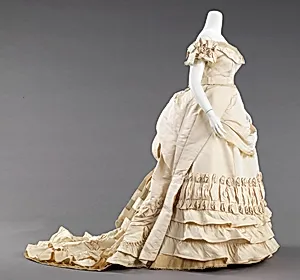
Art Historical Context
In the early 1870s Charles Frederick Worth operated from Paris as one of the first designers to present seasonal collections rather than working solely on individual orders. His silk ball gowns were made for women who attended formal evening events at European courts and in wealthy social circles, where the latest cut and fabric could signal both wealth and access to the newest Parisian styles. This example shows Worth’s preference for letting the weight of the silk itself create volume and movement. The skirt is draped so that the train pulls toward the back left while the front stays comparatively smooth, producing a silhouette that shifts with each step and changes how light falls across the folds. Dated about 1872 and now in the Costume Institute at The Metropolitan Museum of Art, the gown rewards attention to the narrow band of silk loops that crosses the lower skirt; each loop is cut and tacked from the same fabric, turning a small decorative detail into a surface that catches and breaks the light as the wearer moves.